
Shiny things galore while shopping at Uniqlo.
2 comments on Uniqlo

Hot dogs for breakfast? Yes, please!
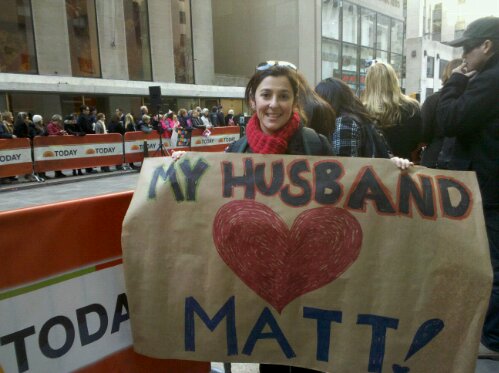
Rachel with our sign, watching the Today Show be filmed!
I love traveling. I love exploring new places. I love seeing new sights.
When a friend recently asked me if I would like to go to NY with her for an “all tourist, all the time” weekend, I didn’t even have to think. Why, yes, I would love to.
We talked about things we wanted to do for the weekend. When I looked at the list, I realized it was aggressive. Would we really be able to do all the things we wanted to? Had we over planned? This, I realized, was a job for a spreadsheet.
I created a Google docs spreadsheet. I created one hour time slots for the three days that we’re in NY. I tentatively filled in what we wanted to do, places to see, restaurants to eat at, museums to peruse.
And we’ve been slotting, and rearranging, and making reservations since. I don’t really believe we’ll stick to our schedule. It is ambitious, after all. However, I am beyond excited for our trip. No matter what happens, we are going to have a good time.
Joan Didion is my favorite author. The first book of hers I read was The Year of Magical Thinking. I literally devoured it. I was so enjoying every page, I found myself skimming, reading fast, aching to learn what happened next. After the first reading, I was spent. It was so raw, so real, I had to rest before picking it up a second time and reading it slowly, enjoying the language, appreciating the grammar. Everything that a slow read allows you to enjoy.
It’s a recount of her life the first year after her husband, Gregory Dunne, died. And it’s still my favorite book. It’s a real account of marriage, loving someone, and the joys and pains that comes with that love. It’s a book about the grieving process, and struggling to survive after losing someone. It’s a book that I pick up over and over again because reading it makes me feel alive.
I was hesitant to read other books of hers. I’ve had experiences where I love a book an author has written and go into a phase where I read as many pieces of literature that they’ve written. And I’ve been disappointed. Tremendously disappointed. Nothing lives up to that first great book. I was hesitant to read other works Ms. Didion wrote. A friend lent me A Book of Common Prayer and I seriously debated whether to read it or not. I did, and I was flooded with the same reverence for the incredible writing that I had when reading The Year of Magical Thinking.
And I’ve read more. Each time I see one of her books at a friend’s house I ask to borrow it. I read it, then buy the book for myself.
Five months ago, a dear friend asked me to reserve Nov 15 on my calendar. I couldn’t imagine what we would be doing. We never make plans five months in advance. Then she told me. Joan Didion was speaking in San Francisco and she bought us tickets. I don’t think I’ve ever received such a thoughtful gift. I marked my calendar and waited.
Part of me feared that something would happen to mar the evening. Speakers cancel engagements all the time. Joan Didion is mature. What if something happened to her? I pushed the evening to the back of my mind. I wouldn’t allow myself to get excited for fear of disappointment.
And then the date was here. I was giddy. I really was going to see Joan Didion. I was going to hear the voice behind my favorite works of art. What would she be like? Would I love her as much in person as in writing?
Yes, I would.
I did.
I hung on to every word of the conversation between her and the interviewer. Many of the stories were from books she had written, so I knew the ending. But to hear her tell the story. To hear her, in her frail voice, pausing between words, sometimes stuttering, to hear her tell her story – was a gift beyond my expectations.
She told of growing up in the Sacramento valley. Of going to school in Berkeley. Of learning to use a computer, learning DOS, and marveling at how logical DOS was compared to her life. Of entering an essay contest, the prize of which was a job at Vogue. Of winning that contest and working at Vogue. Of the personnel manager at Vogue who used to set up a table outside of her office in the morning with small cups filled with barbiturates for the ladies of the office. Of buying her first computer, with a Windows operating system, what she named a Fake Apple. Of arriving at the Royal Hawaiian hotel and having them set up a computer and printer for her and magical days of writing with her husband Gregory Dunne while the tropical rains fell outside the window.
And then the conversation was over. I was happy. I was the complete opposite of disappointed. I was thrilled I had the opportunity to hear her in person.
And then they announced she would be signing books in the lobby. I was shocked. I had assumed she would be tired. The line was long. I looked at Emily. Was she willing to wait in line? (I had brought my copy of The Year of Magical Thinking, just in case.) She was.
We waited in the line that wrapped through the building, and it moved quickly. Before I knew it, I was there, in front of Ms. Didion. She had my books with a post it of my name. She looked at me and smiled. I stammered. “I, I, I, you were awesome tonight. I loved hearing you. You’re one of… no, no, you ARE my favorite author.” My hands were shaking as I said this. I felt like a 12-year old girl, not sure what to say to the boy she has a crush on. She looked at me again. “Thanks,” she said drily as she handed me my books. Lesson learned. Practice what you’re going to say to famous people before you actually meet them. Or, just enjoy the moment.

My godson is 18 and the captain of his high school football team. A lot of information to take in there. MY GODSON IS 18! How did that happen? Okay, topic for another post.
He’s the captain of his high school football team. I am so proud of him. He’s a good kid. He’s funny, he’s smart, he’s humble. I love seeing him lead his teammates. I’ve tried to go to as many games as possible this year. Until Friday, he had won every game I had watched this season. And they wanted to win Friday.
I love high school football. The kids are hungry. They play for the love of the sport.It’s a fun game to watch, no matter what the outcome.
You could tell that George’s team was nervous when they took the field on Friday night. They missed passes. They snapped the ball too high, resulting in a heartbreaking “Oh my goodness, really?” 4th down on the opposing team’s 10 yard line.
But they settled down. Going into the 2nd quarter they were down by a lot of points. And they came back. They ran the ball. They passed. They played hard and played smart. At halftime the score was tied. Yay!
The 3rd and 4th quarters were wrenching. The opposing team, Moreau, made a touchdown. Piedmont made a touchdown. Tie, tie, tie. Until. Until a minute left in the game. With Piedmont’s possession. They made the pass. They made the touchdown. They made the 2-point conversion. Woot! Woot! Woot! With 35 seconds left in the game, Piedmont was winning by one point. Yes.
And then. Moreau had not passed the entire game. They ran. They ran well. Really well. Well enough to score 40 something points. And then, they decided to pass. It was a good play. No one was covering number 47. He caught the hail Mary pass and ran into the end zone.
Ohhhhhhh.
But wait. There’s more.
Piedmont, with 35 seconds left on the clock, was determined to move the ball down the field. And they did. Until the very last play. Another hail Mary pass. The receiver caught it on the 1? 1/2? yard line? And was stripped of the ball.
Ohhhhhhh.
What a finish. So close. Yet, not. I literally felt my heart breaking for my godson. Oh, if I could just step in and take life’s disappointments for him. But I can’t.
Better luck next time, George. You played hard, and you played well. You’ve got a lot of people cheering for you, a lot of believers. You can do it.
A former neighbor, Frederic, recommended a rooftop restaurant in Prague. I discovered, quite by accident as I was wandering one evening, the hotel where the restaurant was located was quite close to my apartment. Knowing Frederic’s exquisite taste, I decided to have my last dinner there, because I knew it would not disappoint. Except, that it was closed because of the cold weather. Sigh. The concierge recommended I try a restaurant, Terasa, in their sister hotel not too far away.
I walked through the winding streets, sure I was lost, then came upon the hotel. I took the lift to the top floor, then climbed a narrow staircase to the small restaurant. The maitre d’ greeted me.
“Do you have any availability for dinner?”
“I’m sorry, ma’am, we are a small restaurant and completely booked for the evening.”
Disappointed, I sighed. “Oh. Okay. Can you recommend another restaurant?”
“Please try the rooftop restaurant at Aria, our sister hotel not too far from here.”
I started laughing. “They sent me here. They’re closed for the winter.”
He laughed too. “One moment, ma’am.” He left and came back a few moments later.
“The kitchen says if you would like to eat right now, we can serve you.”
It was only 4 pm, but I was starving. I had been sightseeing all day and had not stopped for lunch. “That would be lovely.”
He escorted me to a table for two to a window overlooking what seemed to be all the rooftops of Prague.

He took my coat and pulled out the chair for me. After I sat down, he lit a candle on the table. Being the only person in the restaurant, I felt like a queen. As I perused the menu, I realized that no matter what I ordered, it would be delicious. After two plus weeks of eating heavy meat dishes, I was ecstatic to see several seafood dishes on the menu. After I ordered, he returned with an amuse-bouche of salmon terrine. I love the concept of amuse-bouche. I’ve never taken French, so I don’t know the direct translation, but in my mind it means, “A little kiss of food. Just for you.” It’s always a surprise when it arrives and I’ve never been disappointed by what the chef offers.

The first course was a goat cheese and sun-dried tomato mille feuille. When I saw it on the menu, I liked all the ingredients, but, have never taken French, was not sure how to pronounce it. “I’ll have the mmmmm….” I said, pointing at the menu. “Ah, the mille feuille. An excellent choice,” rolled off the waiter’s tongue.
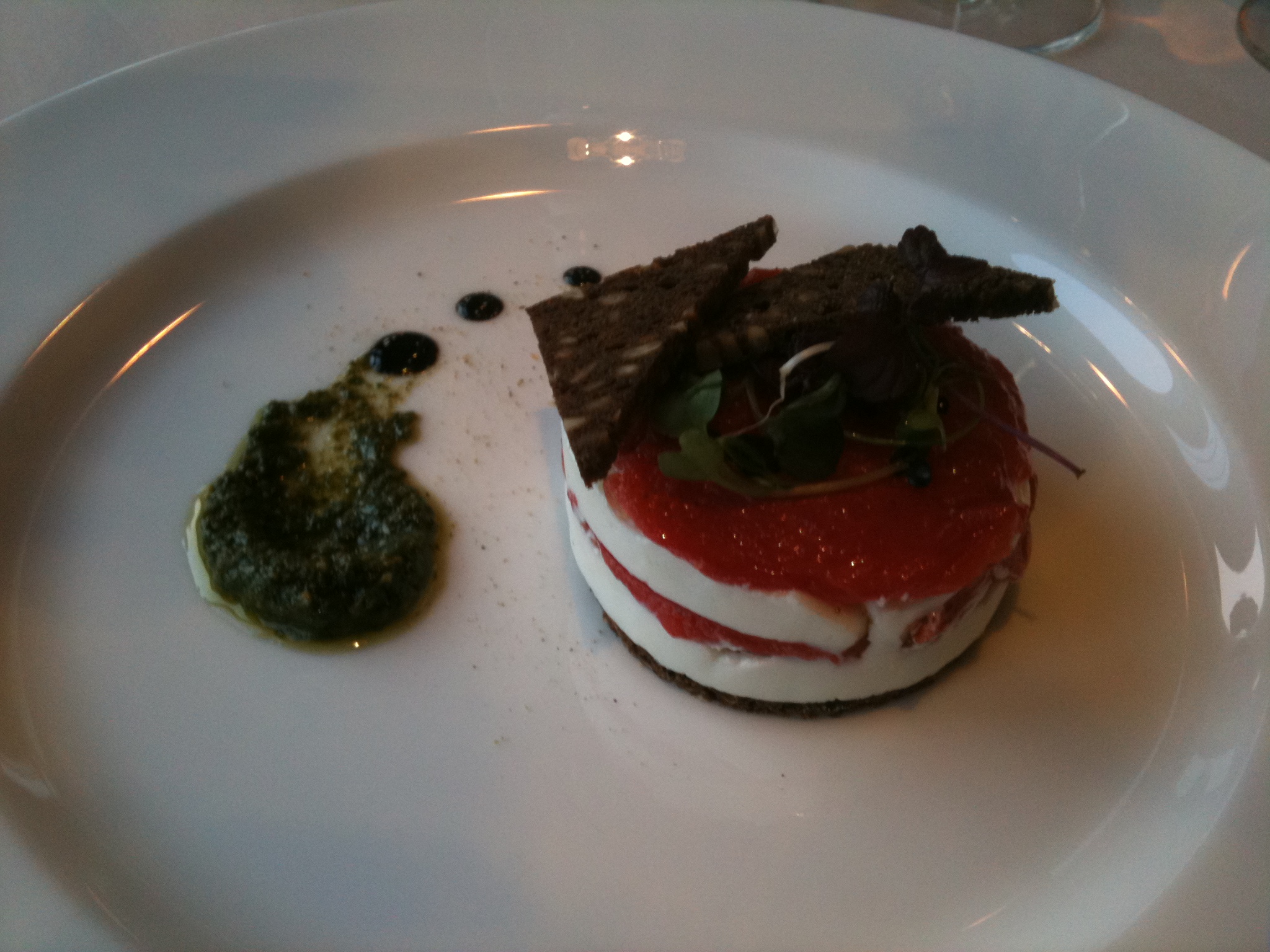
It had a delicious pesto on the side, which complemented the richness of the goat cheese nicely. For my main course, I ordered a seafood risotto. When I ordered it, the waiter described a special of the day, which I assume was also seafood. I couldn’t understand what he was saying, even after asking him to repeat it several times. In my head I was thinking, “I don’t want to be *that* American. The one that says, “Huh?” “What?” So I smiled and said, “That sounds delicious, but I think I’ll try the seafood risotto. Thank you.”
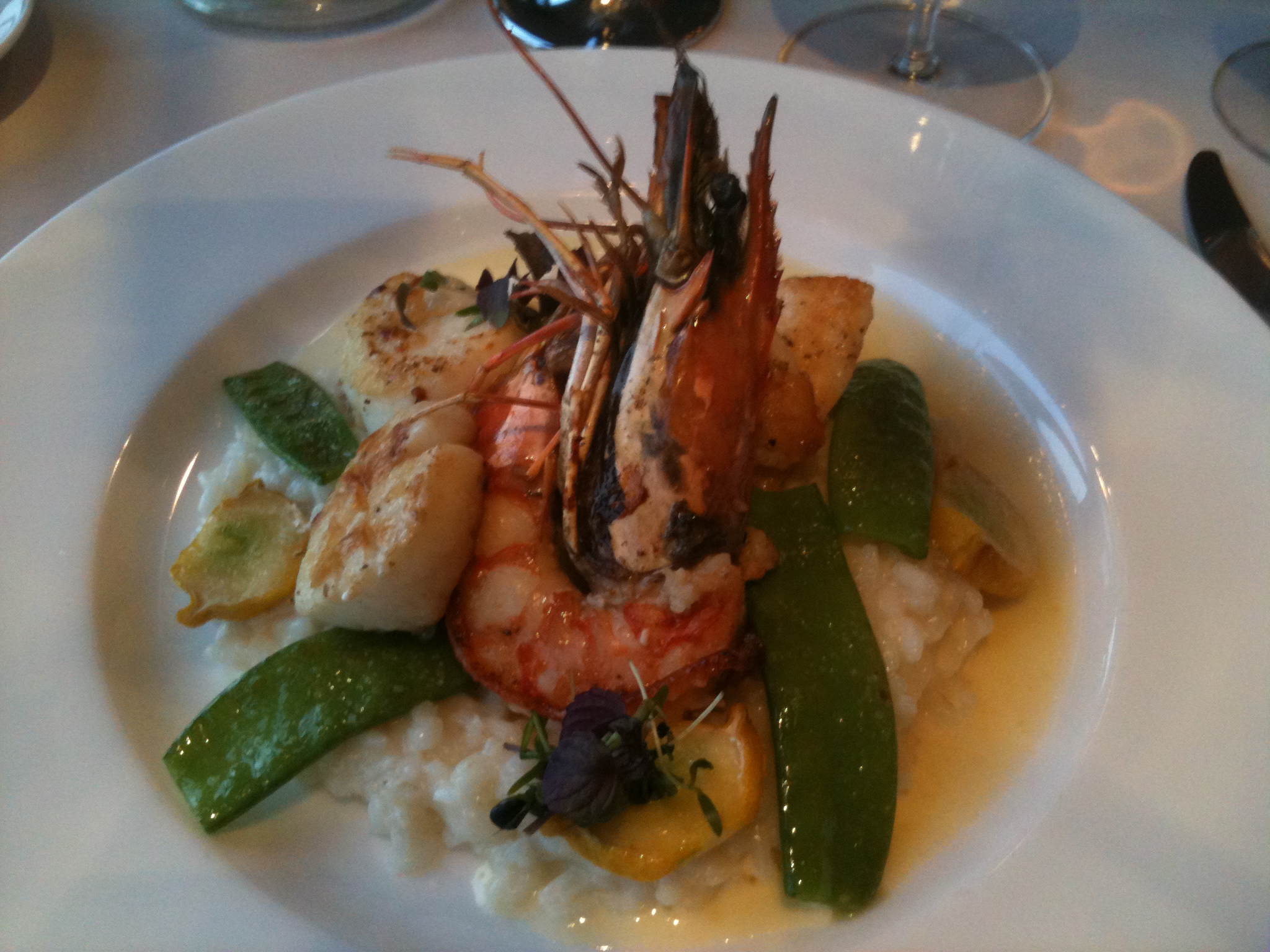
And I wasn’t disappointed. It came, a plate of creamy seafood with a light garlic sauce surrounding it. Grilled John Dory, a huge tiger prawn, a few tender scallops, crisp snow peas, and grilled baby squash sat upon the clouds of risotto.
At this point, I was watching the sun set and the lights start to flicker on in the town. I was thinking about how my vacation couldn’t have been any better. For five days, I had been surrounded by beautiful music. I had eaten delicious local cuisine. I had been surrounded by beautiful design, almost everywhere I went. I had ridden a train through Hungary, Slovakia, and the Czech Republic. I was feeling very lucky, and very grateful.
And then he offered me the dessert menu. I guess sometimes life can get better. I asked him what his favorite dessert was. He grinned, then said the creme brulee sampler. Creme brulee? My favorite dessert of all time? Four individual ramekins of deliciousness, all different flavors? Yes, please.
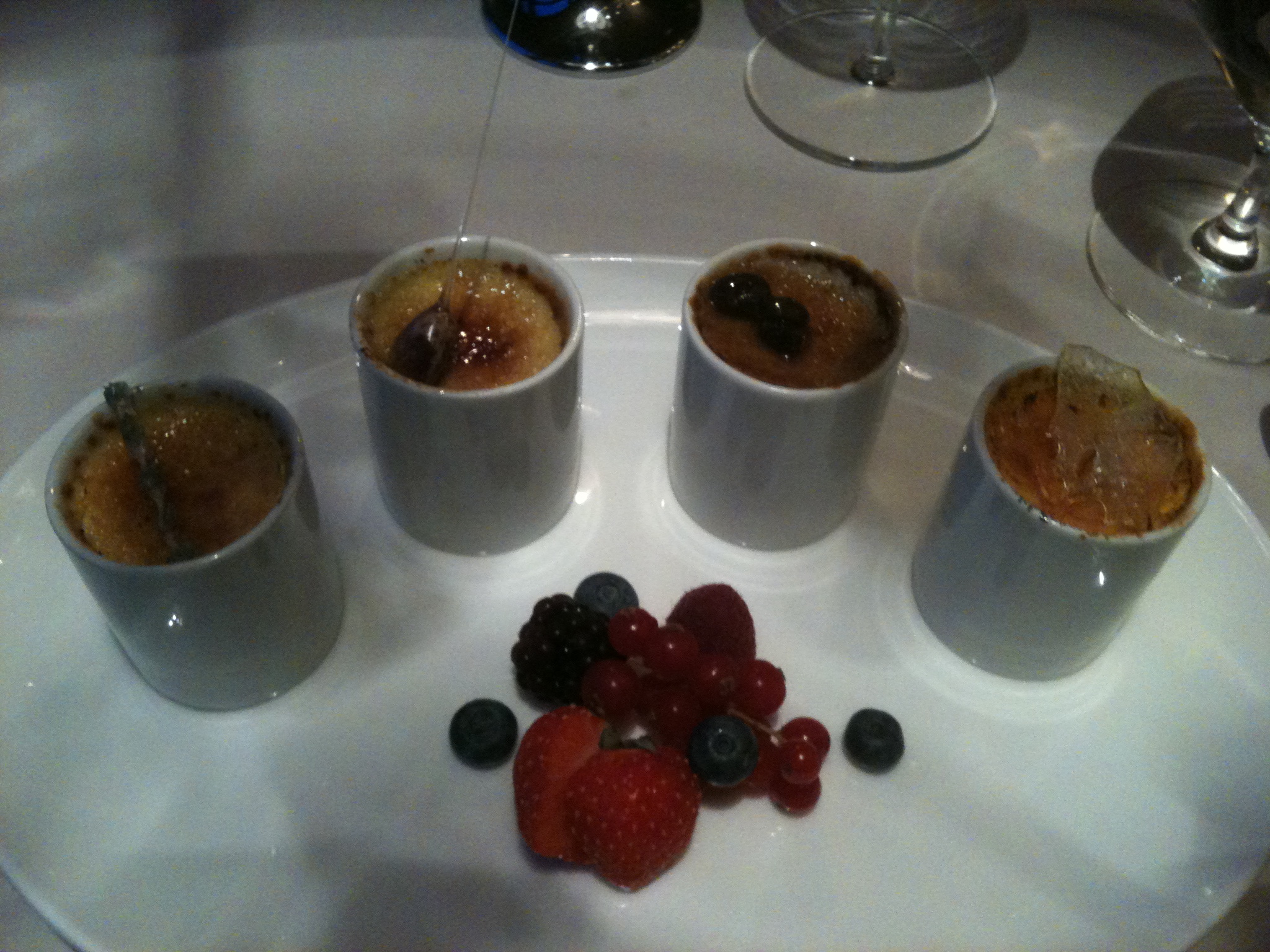
The creme brulee was perfect. Tiny ramekins, a couple of bites each, of deliciously flavored sweetness – lemon-thyme, pistachio, coffee bean, and saffron. Somewhat to my surprise, the saffron was my favorite. The savoriness of the saffron contrasted nicely with the sweetness of the creme.
And that was my last supper in Prague. A perfect way to end a perfect vacation.


I wanted to go, and at the same time I didn’t want to go. I imagined that it was one of those experiences that I would remember, or that would move me, but wouldn’t necessarily be fun. I hadn’t planned to visit a concentration camp; the opportunity snuck up on me. In my limited understanding of world history, I assumed all the concentration camps were in Germany. While perusing tourist opportunities here in Prague, I came across an ad to visit Terezin, the Czech concentration camp. I decided to go.
We drove an hour north of the city. We entered a museum of sorts, filled with memorabilia and documentation in Czech, German, English, and Hebrew. There were photos. Drawings. Diary entries. Yellow Star of Davids with “Jude” written in them. Video clips. Rosters. Quotes. Two floors of history. And a showing of a propaganda film, “The Gift of a Town.” I took all this in, interested, curious, realizing my knowledge of World War II has significant gaps.
Next, the cemetery. We walked down a long road flanked by trees losing their leaves. The first thing we saw was an oversized menorah, surrounded by hundreds of identical tombstones. The day was cold and grey, fitting for visiting a cemetery. I walked among the tombstones, noticing that small rocks had been placed on top of many of them. The tour guide called me to join him near a building.
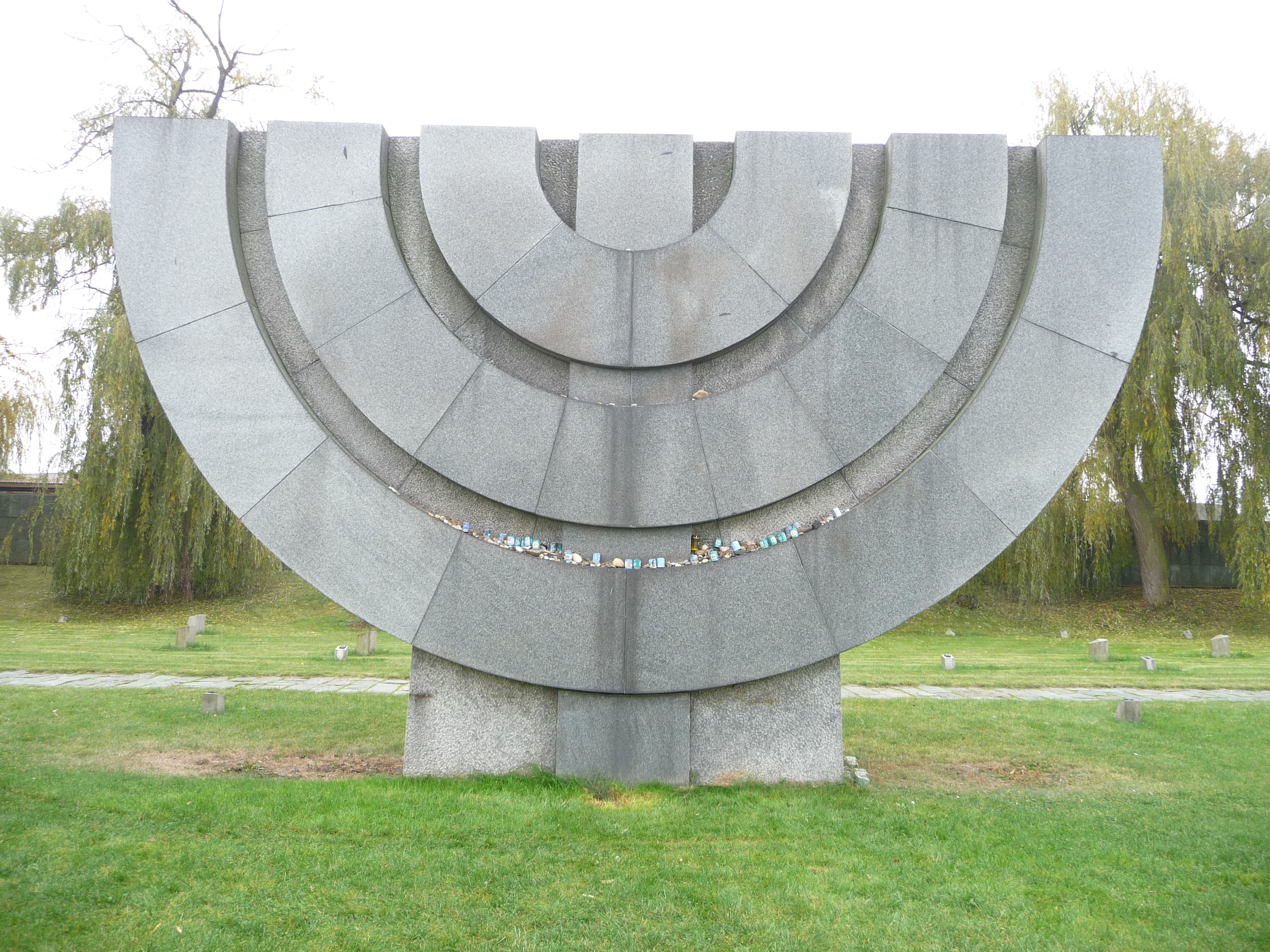
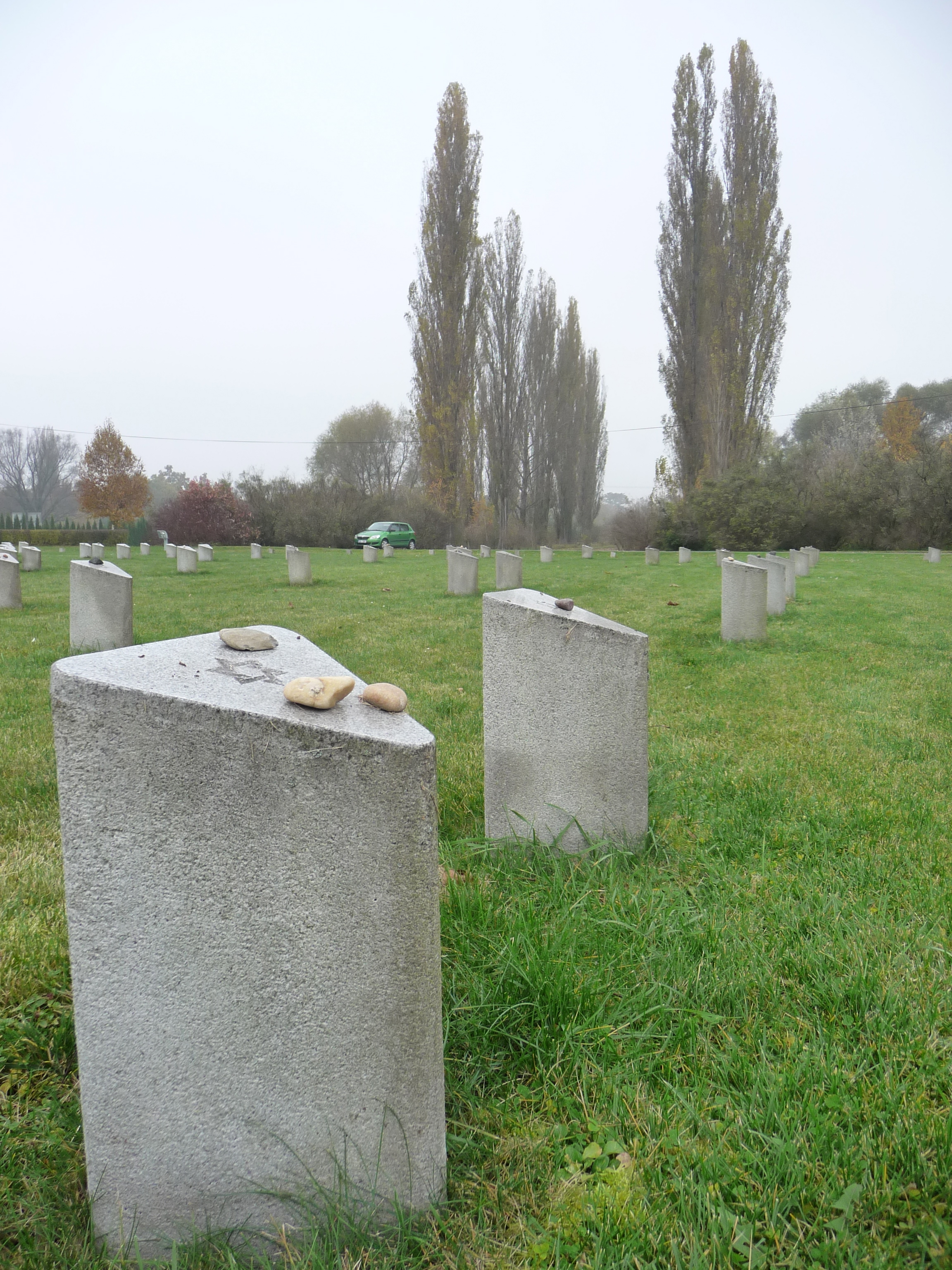
“We’re now entering the crematorium,” he said as he walked ahead of me. Oh, wait. Crematorium? I didn’t remember reading that on the brochure. I hesitated. Was this really something I wanted to do? Not sure, I followed.
As I entered, I felt as though the air had been sucked out of my lungs. Even after 65 years, death was present. I quietly walked around, lit a candle, said a prayer of remembrance, then waited outside.
Our next stop was the Small Fortress. This was where political prisoners, Jewish and non-Jewish, were imprisoned. Because I was the only English speaker in our French tour group, I had my own guide, Camille. She led me through various blocks, group cells, solitary confinement cells, the sick room with only 12 beds (more people were sick than that, she explained, but most stayed in their group cells, infecting the others), and the arch which read “Arbeit Macht Frei” – work will make you free. She leaned over to me in a confidential stance. “Of course,” she whispered, “that was a lie. Once you entered the Small Fortress, you were never free.” We continued walking.
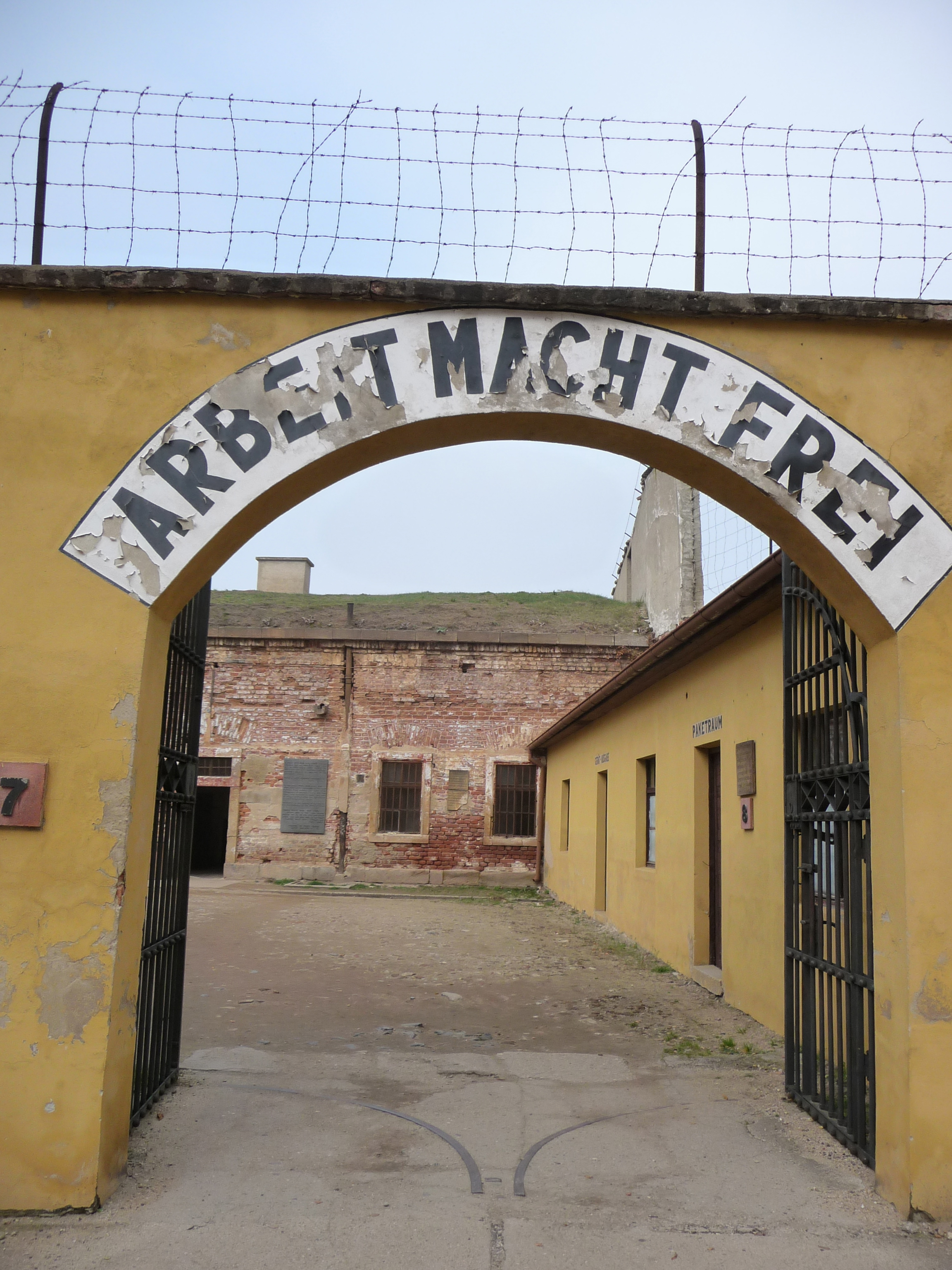
We walked through more blocks of cells, then came to an opening in the wall. We stopped. “This is a happy place. This is where three prisoners were able to escape.” Camille then explained that others attempted escape, were caught, and were executed, in addition to a few prisoners selected at random, to act as a warning to the other prisoners not to attempt escape.
“Are you claustrophobic?” I shook my head no and she motioned for me to descend stairs to a tunnel. The ceiling was barely six feet; I could feel how close the top of my head was to the rough stone. “Walk,” she said. I walked; she followed directly behind me. I assumed that at the end of the tunnel there would be another staircase leading back outside. Instead there was a turn. And another long tunnel. And another. After about ten minutes of walking in silence, I began to second guess my confident answer claiming I wasn’t claustrophobic. This would be the ideal place to commit a murder. Camille wouldn’t kill me, though, right? I mean, surely the Frenchies would notice I was missing. The tunnel became more and more narrow.
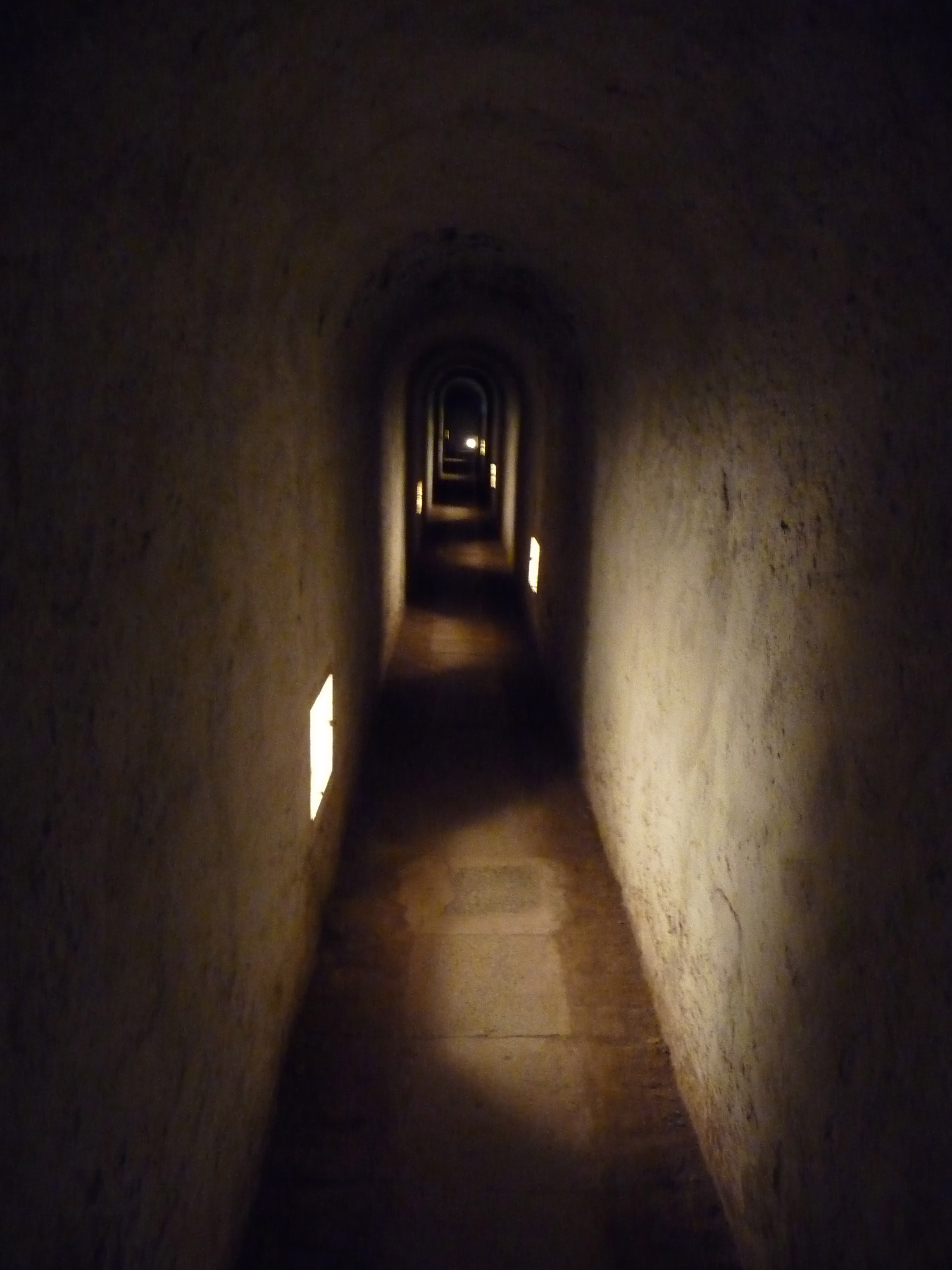
Why wasn’t she sharing tour information with me? She had been quite chatty up until that point. “So, what were these tunnels used for?” “The Germans blocked them off. They weren’t used for anything during WWII. Before, however, when this was a fortress, they would lure enemies into the yard outside then shoot them through the small gun holes.” Oh. After what felt like an eternity, we emerged from the darkness. Into the execution yard.
Stories of execution were followed by a tour of the officers’ quarters (they even had a swimming pool and a cinema) then another cell block. Towards the end of the war the Germans didn’t want any prisoners near the advancing front, so they transferred prisoners to an already crowded Terezin. Group cells that were meant for 50 people contained up to 400. 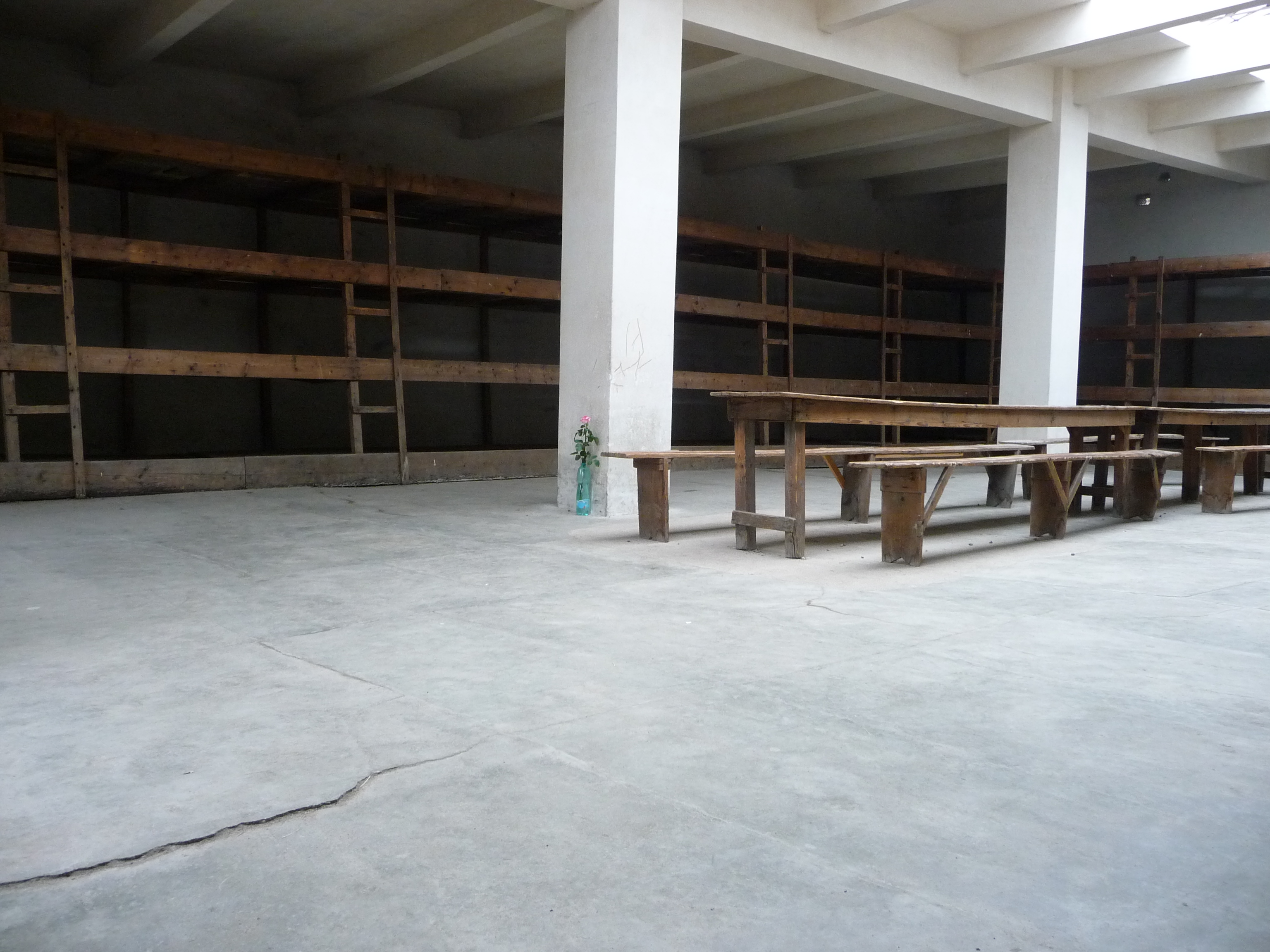
And with that, the tour was finished. Not fun, but forever etched in my memory.
Prague = music.
Everyday here I have been surrounded by music. A chamber concert in a beautifully restored hall, complete with art deco stained glass windows and an intricately painted ceiling. Dixieland jazz, on the river front. Showtunes on the grand piano as I dine, savoring Czech delicacies. And then tonight, an impromptu performance with an accordion player on the sidewalk.
The streets were eerily empty as I walked home from dinner. I heard an accordion playing in the distance. As I walked, the notes grew louder. The musician, along with a friend, appeared, coming round the corner, walking towards me. The first few notes of Dream a Little Dream of Me eked out, the musician half-heartedly singing along. We passed each other as he played the chorus. I joined him in song, “But in your dreams, whatever they be…” We passed, then turned round to face each other, singing, “Dream a little dream of me….”
I’ll miss you, Prague.
 LoriLoo