I arrived. She was snoring, which meant she was still alive. The staff told me she ate a few bites of breakfast then was so tired they put her back to bed.
So I’m sitting at her bedside, waiting for each breath in, and experiencing relief with each snore out, and crying.
I’m holding so many opposing thoughts at once. I want her to be at peace. I want more time with her. I don’t want her to be in pain. I wonder if the meds are hastening her death. I miss my team at work. This is the most valuable way I can spend my time.
I wonder what’s going through her mind. Does she realize she’s preparing for death? Does time have any relevance? Can she differentiate between all the women holding her and whispering they love her? Does she know she’s loved?
Matt, we’ve worked together for over thirteen years. That’s over a quarter of your life! And over a fifth of mine! Here are a few things that I’m grateful for, which you are directly responsible for. I want you to understand the impact that you’ve had on my life.
The first line of Automattic’s creed is “I will never stop learning.” This was scary in the beginning. Didn’t you hire me because of my expertise? Over time, I embraced this in both my professional and personal life, and my team jokes that my favorite phrase is, “I’m curious…” This mindset has helped me navigate caring for my mother with Alzheimer’s. Instead of insisting on “right,” I’ve instead approached situations with “Tell me more about that.” It’s not scary to be wrong anymore. I appreciate the learning that comes with each mistake I make. I find myself saying, “strong opinion, loosely held” much more often and encouraging folks to tell me what I’ve missed.
I am blown away by the people you hired to work at Automattic. I had worked in tech before I joined Automattic, and had worked with many geniuses that weren’t very kind. When I joined Automattic, there weren’t many of us, and every person I met was incredibly smart, interesting, and kind. It was somewhat intimidating, and then oh so rewarding. I value the relationships with people I’ve met while working at Automattic – those who still work there, and those who don’t.
Thank you for championing a distributed workforce before it was in vogue. This allowed me to move back to North Carolina when I was ready to leave the city life of San Francisco. It allowed me to temporarily live with my parents when my father was going through treatment for cancer. It opened so many opportunities to share our successes (and speed bumps) during the pandemic to others who were forced to adopt a remote working environment, perhaps before they were ready to. In the spirit of open source, you encourage us to share openly. I shared policies, practices, snafus, and posts with colleagues at other companies. They were grateful for the help, and I was grateful I could help.
Thank you for caring about Automatticians. You have been incredibly supportive as I have taken the last few months to focus on my mother. This may be the greatest gift I’ve ever received. I have been able to hold her hand, spend precious days with her, and assure her that it’s okay to join Dad, that we’ll be okay here. And without the pressure of knowing that I have hundreds of emails to respond to, or meetings to schedule my visits with her around.
There have been rough spots during our thirteen years together. There have been times when we have vehemently disagreed on an approach. There have been times when words have cut. I have no doubt we will continue to disagree in the future. And we will continue to learn from each other. And I look forward to what you will accomplish in your next forty years. Happy birthday. ❤
When I entered Mom’s room on New Year’s Day, she was still in bed asleep, though it was almost noon. I could tell by how she was curled up in the fetal position and the grimace on her face that she was in pain. The staff mentioned that she had been in pain all night, in and out of sleep, and had fallen when she tried to get out of bed that morning. I bent over her and kissed her forehead and she groaned. I stroked her hair and she wailed. Anywhere I touched her she cried out in pain. I asked the staff to please administer the morphine dose that was to be used as needed. It didn’t seem to help, Mom continued to cry as I held her. I cried as well, quietly at first, and then not so quietly. She looked down at my head on her chest and clearly said, “What is wrong with you?” The iciness of the words let me know that part of her was still in there; she had used that phrase often as I was growing up, particularly when she wasn’t happy with my actions. Those were the only words she said clearly that day.
A hospital bed was wheeled into her room later that day (she had been sleeping in her own bed up to that point). We transferred her to the hospital bed and I sat beside her and continued to hold her hand, telling her it would be okay.
Since New Year’s Day, she’s stopped eating food, seemingly forgetting how to chew, and not interested in purees. She can’t seem to work out how to use a straw, and simply curls her mouth around it. I give her liquids with a syringe or with a sippy cup (often spilling the juice down her gown or shirt and apologizing profusely while dabbing at the errant drops). She lays in bed staring with glassy eyes at something I can’t see. Occasionally she’ll try to talk, but the words come out as garbled sounds, as though her mouth is full of pebbles.
Today we transferred her to a wheelchair. I asked her if she’d like to go for a ride and she nodded and mumbled, “Oh, yes.” I wheeled her chair up and down the hallway; the same hallway we had shuffled down just last week. She yawned and I asked if she was tired, and she stared at me then after a long pause in which I started to think she hadn’t heard me, said, “Yes.” We transferred her back to her bed, and immediately heard her snores. I sat beside her, holding her hand as she slept. At one point her eyes flew open, and she yelled, “Jerry!” I told her Dad was with her, and silently asked Dad to help her with this transition, so that she’s not in pain. And also said a moment of thanks that I still have these moments with her. Even though we’re not speaking, this time is so precious. I hold her hand, whisper all the things I’ve told her before, and all that I haven’t, and am grateful for one more day together.
Mom stared at me quizzically when I entered her room. I said (loudly, because she won’t wear her hearing aids), “Hey Mom, it’s Lori, your daughter,” and went in for a hug. She trembled then melted into my hug. She mumbled, took my hand, and in her socked feet, started shuffling towards the living room. We got to the love seat, and I helped her turn around and lower herself onto the cushions. I sat beside her and she snuggled closer. I put one arm around her, and held her hands with my other hand. She dropped her head onto my shoulder and promptly fell asleep. We stayed that way for an hour until her beau shuffled up and said, “Hey! What ‘cha doing?” Mom drowsily opened her eyes and patted my leg, her cue for “Let’s go.”
I helped her stand and we shuffled through the two hallways. She shuffled back to the love seat and stood there. I asked her if she’d like to rest, and she nodded. I positioned her in front of the love seat, then gently sat her down. I put my arms around her to hug her, and she again put her head on my shoulder and fell asleep. A bit later, the hospice social worker arrived for her check in. In a whisper, I asked her to pull up a chair. Mom stirred and I stroked her hair. As the social worker and I talked in hushed voices, I wondered if Mom really was asleep, or if she was pretend sleeping like I used to do as a child, eavesdropping on the adult conversations.
After the hospice worker left, Mom awoke and pulled my hand. “C’mon.” I helped her up and we did a lap through the facility hallways then ended back on the love seat for the third nap of the afternoon. There are days, like today, when a simple walk tires her out and most of our time together is spent napping. I don’t mind these days. I focus on how her skin feels, what her hair smells like, the rhythm of her breathing. I want to sear it into my brain so that I’ll never forget. I know I will forget.
Upon the third waking, Mom rubbed her eyes, looked at me, startled and afraid, and said, “Who are you?!?!” I hugged her tight, kissed the top of her head, and told her I loved her. I’m the person who loves her.
After our standard greeting of a long hug and me saying, “I love you,” and Mom parroting my words (which happens often now), Mom leads me to the somewhat dingy brown love seat in the common area. I really try not to be a germaphobe, and it takes so, so much effort, especially on upholstered furniture, where residents may have had accidents. “It’s okay,” I remind myself. “There are more important things. Being here with Mom is what is important. Everything can be washed.”
I sit down, and help her into her spot beside me. She snuggles close and lays her head on my shoulder. I put one arm behind her and pull her close. With my other hand, I stroke her bare arm, shocked she isn’t in layers of clothes, as she always complains she is cold. Her skin has always been so soft. It’s becoming thinner and thinner, and age spots are becoming more prominent. The age spots have a different texture, almost sand papery. My fingers catch on them a little as I rub my hand over them. This fascinates me.
Mom mumbles as she lays on my shoulder. Every so often I hear what might be a word and I repeat it. Mom agrees and keeps on. It’s a cold, gray day outside. This feels right, to be inside, on a love seat, snuggled close together.
Her beau, shuffling through the room, calls me by his daughter’s name, Sherry. At first, I don’t respond, and he keeps yelling til I say, “Hi there, whatcha need?” He wants to know what we’re doing, sitting there, hugging each other. I tell him we’re just talking. He thinks for a moment, then satisfied, he saunters away.
Another resident leans over a table in the corner. Perhaps he worked in the government. Perhaps he was a spy. Perhaps he has other voices in his head. Perhaps all of that. He runs his fingers over the grain of the table and says that it’s important that we keep watch. We can’t let them in. He asks if we’re being careful. I assure him we are.
I attempt to take a selfie of me and Mom every time we’re together. Lately, though, when Mom sees the phone, she thinks I’m trying to show her something, and she reaches to pull the phone closer so that she can see. I have a lot of pictures similar to this on my camera roll.
Bathroom
Mom tells me she needs to go to the bathroom. We walk the twenty steps to her room and I help her into the bathroom and slide the bathroom door closed. She positions the trash can behind her as though she’s going to sit on it. “Hey Momma, let’s go this way,” and I guide her gently towards the toilet. “Oh, yes.” She stands there, in front of the toilet. I ask her if she needs to use the bathroom and she says yes. I help her pull down her corduroy pants, and start to pull down the adult diapers that she now wears. She smacks my hands and says, “No!” I step back and ask her if she needs to use the bathroom, and she says yes as she pulls up her corduroy pants. She gets the elastic waistband of her pants situated just so, then tells me she’s done. Sometimes yes means yes, and sometimes yes means no. There isn’t rhyme or reason to when the meaning is true, and when it’s the opposite.
Nap
Mom lets out a large yawn. “Are you tired?” She nods and we walk to her bed. I’m wondering if this nod means yes, or if this nod means no. “Would you like to lay down?” “Yes,” she says as she tries to pry off her tennis shoes, unsuccessfully. As she sits on the bed, I kneel down to untie her double knotted shoelaces. She crosses one leg over the other and kicks me in the head. “Sorry!” I laugh and continue to take off her shoes. When I stand up, she hugs me tightly around my waist, and says, “Sorry. Sorry. Sorry.” “Hey, Momma. It’s okay. It’s okay.” She leans backwards and skooches further onto the bed. She turns to one side and curls up. Okay. So yes meant yes this time. I crawl onto the bed behind her and put my arm over her. She holds onto it tightly with both hands. Pretty soon I can hear her breath, in a steady rhythm, in and out. In and… Oh goodness. Has she stopped breathing? And out… I continue to listen to her breathing, and then hear her snore. She shifts a bit and I realize it is my snore, not hers. I change my breathing so as not to disturb her.
Dinner
I sit next to her at the table, in yet another upholstered chair, overlooking the stains and refusing to think about what they might be. The angel on staff places a plate in front of Mom. Cream of broccoli soup in a small bowl, and a meat and cheese sandwich, cut into triangles (the proper way to cut a sandwich), not rectangles. Mom picks up the bowl of soup, and attempts to pour it onto her plate. I gently tip her hand back so that the soup won’t spill, and guide her to set the bowl on the table. I ask Mom if she’d like some soup. She nods, so I bring a spoonful to her lips, prepared for her to swat it away. She opens her mouth and eats it, and seems to like it. I continue feeding her spoonful by spoonful until she notices the sandwich. I pick it up and hand it to her, and she gingerly bites one point of the triangle. Then another point. I’m so happy to see her eating. There are so many days when she simply refuses. She eats an entire half of a sandwich. I give her another spoonful of soup. Once the chunks of broccoli are gone, she has no interest in the soup. She picks up the other half of the sandwich and I’m astonished. This is the most I’ve seen her eat in a month. She finishes the second half of the sandwich. I hug her and kiss her forehead. She is handed a fudge cookie, wrapped in plastic, for dessert. She can’t quite figure out how to pull back the plastic, so I pull it back halfway, so that her fingers won’t get sticky. After she eats the unwrapped half of the cookie, she puts the plastic wrapped portion in her mouth and sucks. I pull back a little more plastic so she can access the cookie. She uses her fingers to push the cookie into her mouth. She hates having sticky fingers, a trait she has passed on to me. As I watch, she dips her fingers into her cup of chocolate Ensure, then rubs her hands together as though she’s washing her hands. This makes her hands stickier, and she is growing agitated. I help her out of her chair and lead her to her bathroom, where we wash both of our hands under warm water, using an ample amount of soap.
Bedtime
I help Mom into a nightgown and long underwear. We take off her shoes (again). She lays down on her side, facing me. She pats the bed, so I sit in the curve of her body. She wraps her arms around my waist. I stroke her long, silky, gray hair. Her eyes grow heavier and heavier. Each time I stop stroking her hair, her eyes strain to flutter open. So I continue, alternating with stroking the place where her eyebrows once were, remembering all the times I begged her to “play with my hair.” I love the feeling of someone running their hands through my hair, of brushing it, of braiding or twisting it. So many times she told me no, that she didn’t have time, or she was too busy. I love that I can give her this gift of comfort.
I walked into Mom’s room as she held a wicker basket to her lips and tipped it backwards. “Hey, Momma. Are you thirsty?” She nodded and continued to tilt her head further backwards. I gently took the basket from her hands and gave her a glass of water. She sipped it, and sipped it, and sipped it, emptying the glass in a few swigs.
We walked to the car, and I helped her get in the passenger’s seat, then buckled her seat belt. As I settled into the driver’s seat, I noticed she was gnawing on the seat belt. “Are you hungry?” “No,” she said as she continued to chomp on the tough webbing.
At our favorite restaurant, Mom pushed her food around her plate with her fingers. Utensils prove to be too challenging these days. I tore part of a chicken tender into a bite size piece and fed it to her. She chewed methodically, staring into space. “Momma, want a French fry?” I asked as I held one out to her. She took the long skinny potato, inserted it into her mouth, and began the motions of brushing her teeth. After a few seconds, she switched to the other side of her mouth, then laid the soggy French fry on her plate.
At the park, we sat on a bench, listening to bird songs and watching clouds drift by. She leaned over and picked at my sneaker. “What ‘cha need, Momma?” Wordlessly, she picked up my heel, put it in her lap, and cradled it like a baby. She rocked it gently back and forth, looking at it tenderly. I felt a cramp sneaking into my hip, so I turned slightly so that she could continue rocking, and I would (hopefully) still be able to walk when she was finished.
What is she seeing with her now glassy hazel eyes that used to be the color of black coffee? What is she dreaming of as she rocks my foot? Does the wicker basket quench her thirst? Is it the motion of drinking that satisfies her? Or is it the actual liquid in her throat? I hold her tight and kiss the top of her head, wishing I could understand her thoughts.
I sensed I was walking into a not-great situation. One of the newer employees was standing over Mom, who was sitting in a chair, her back to me. The employee was staring Mom down and wagging her finger at her. “Heyyyyyy,” I said tentatively as I walked up behind Mom. She turned around and stared at me with a look I recognized from childhood. She was furious and steely eyed.
I bent down to Mom’s level and hugged her. “Hey Momma. I love you.” The employee said, “Miss Sybil, why don’t you tell your daughter what you’ve done this morning?” I looked up at the employee questionably. “Um… I don’t think that’s going to happen. You know she has Alzheimer’s, right?” After no response from either, I said to the employee, “Why don’t you tell me what happened?”
She went on about how Mom had wandered into another resident’s room, and spilled some pineapple juice. And Mom had walked in on another resident using the bathroom (to be fair, he keeps his bathroom door open at all times…). And Mom had poured the coffee out of the carafe in the kitchen. And she had thrown away the remote controls, and now they would have to buy new ones. The whole time I hugged Mom tightly, and covered her ears. I didn’t want her to her the condemnation in the woman’s voice. When she finished, I simply looked at her and said, “You do realize that Mom isn’t doing any of this intentionally. She’s preparing to die.” The employee told me she knew all about death, that she cared for her mother for seven years. At home. I didn’t need to tell her anything. My steely-eyed gaze matched Mom’s. The employee said she was going to fix lunch, and would Mom like something to eat? “No.” She’d be happy to fix me a plate as well. “No.” She left to go into the kitchen, but before leaving, said, “This is the calmest that Miss Sybil’s been all day.” I wanted to scream and say, “It’s because I’m not yelling at her!” Instead, I stared at her silently and pulled a chair up beside Mom.
I continued to hug her and rock her. She cried on my shoulder, and mumbled, occasional words rising. “Kill,” “hurt,” “Jerry.” I was listening with my heart, not my ears. “Dad’s right here, Mom. He’s okay. No one’s going to hurt him. Are you ready to see him?” She continued to cry against my shoulder, and I found myself crying as well. Crying because this is such a cruel disease. Crying because I would remember this, and grateful that Mom wouldn’t. Crying because, well, that’s all that I could do.
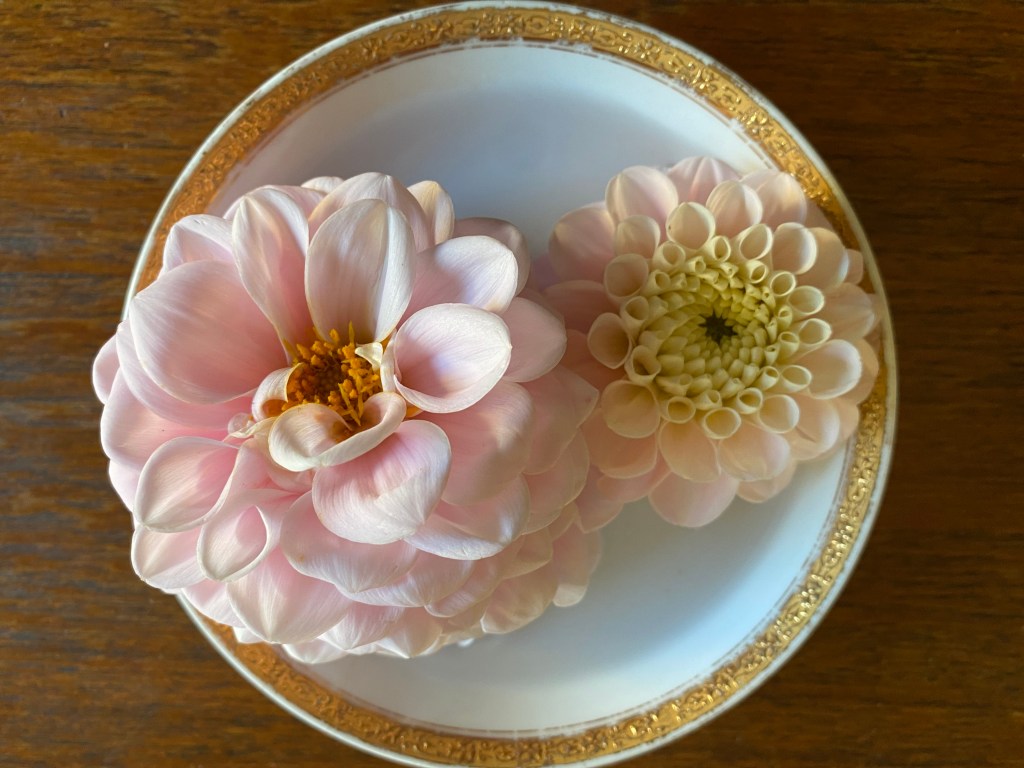
Temps dropped below freezing here. I didn’t expect any of my dahlia plants would survive the freeze, so I clipped blooms and made beautiful bouquets to be enjoyed indoors.
A change in medication has triggered Mom’s talk function. She talks constantly. Which would be comforting, except that her speech is complete gibberish. She produces sounds, but not words, for the most part. And she appears to be making so much sense to herself. Her body language matches the inflection of her sounds. I act as though I understand her, and nod along, or say, “Really?” or “No!” or “Tell me more!” at appropriate intervals. She seems to enjoy our “conversations.” I’m devastated I can’t understand her. I would love to know what she’s saying.
My mind flashed back to the trip we took to London in 2003. It was the 100th anniversary of the Wright Brothers’ first flight, and round trip tickets to London on British Airways were $100. Mom flew from Atlanta and I flew from San Francisco and we met in Heathrow. I was so excited. I wanted so badly to have a positive experience with Mom. I thought this would be it. A week, just the two of us, exploring London and going to the theater. A mother-daughter experience to remember forever. We shared a room in a bed and breakfast with two twin beds. At night, I would pepper her with questions. “What did you enjoy about today?” “Tell me about when you lived in New Orleans.” “What was it like to have four siblings?” “What was it like to move around so much as a child?” “What first attracted you to Dad at college?” She shushed me and told me it was time to sleep. During the day, it wasn’t much better. She answered me with curt responses, and I finally accepted that this might not be the vacation I dreamed it would be. Our conversations were restricted to logistics. In Heathrow, as she was headed towards her gate for Atlanta, and I was heading for my gate to San Francisco, I hugged her and told her I loved her. She told me this was the best trip she had ever taken. I stood, dumbfounded. This might have been the most uncomfortable trip I had ever been on. She barely spoke the whole week. I hugged her again and told her I was so happy she had had a good time.
As we walked around the outside of the facility today, we passed by a fire hydrant painted yellow with a white top. She stopped to speak to it, then laughed. I laughed as well, and when we started walking again, she turned and waved goodbye to it. She seems to relish being “the funny one” and is delighted when I laugh, and then she laughs, and then tears are rolling down our faces. Growing up, Dad was the funny one. He was so witty, and charming, and articulate. And Mom didn’t talk much. She wasn’t shy. When she had something to say (which was often critical) it was said. And she wasn’t often the life of the party. I’m happy for her. She seems happy. Confused at times, but for the most part happy. She has a beau who loves on her. She enjoys going to the ice cream shop and having me feed her spoonfuls of cookies and cream ice cream. We enjoy sitting in the sun on the patio and holding hands. I try to remember this, and be happy for the life she’s living.
I arrived, expecting another day of laying in bed with Mom, holding her as she slept.
She wasn’t in the Geri Chair in the kitchen.
She wasn’t in her room, and the windows were open, curtains fluttering in the wind.
My throat seized up. In Appalachia, when someone is near death, you open the windows, so that their soul isn’t trapped. Oh my god. Did Mom pass and they forgot to tell me?
A nurse saw me and told me Miss Sybil was in the courtyard. I shook my head. What? I asked, “My mom? She’s out of bed?” She nodded and pointed.
Sure enough, Mom was sitting in the sunshine, next to her beau, basking in the warmth of the October day. It was such a cognitive dissonance from my previous visits that I had to stand there a moment to take it all in. She saw me, stood up, and walked towards me, shaking and crying. “My baby! My baby!” I was flabbergasted.
I hugged her tightly, her head resting on my chest. “There, there,” I said as I stroked her hair. She took my hand, and we walked the courtyard, her in socks, relishing the warmth of the sidewalk on her soles. As we circled back to where she had been sitting, her beau said, “Where y’all going?” I replied, “We’re just walking.” He told us that he’d be right there. I nodded and he said, “When y’all decide to start stripping, I’ll be right here. Okay?” I couldn’t help but laugh. Maybe it’s not funny. But it is. And when I laughed, Mom laughed. And then her beau laughed. And there we were, under the perfect blue October sky, relishing the warmth of the sun, and guffawing loudly.