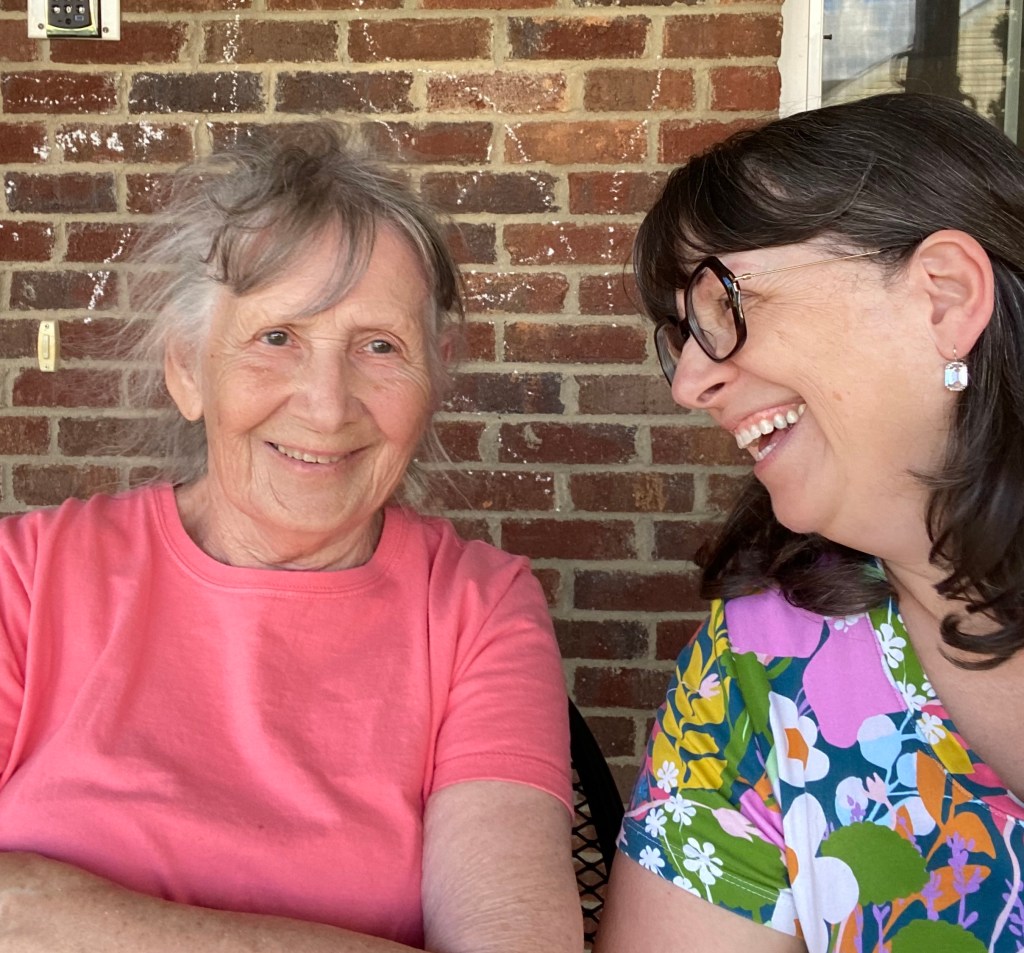
It’s becoming painful to be around Mom. She’s so confused; my heart breaks for her. She’s so restless. Even on sedatives, she is unmoored. She lays down, she tosses and turns, she gets up after a few minutes, she walks around aimlessly, as though she’s searching. She sees things that I can’t, she reaches into space to grab something that’s not there. She swats at me. She tries to eat my hands when I attempt to feed her. Her words generally don’t make sense to me. I feel so badly that she’s communicating in a way that is coherent to her, and I simply cannot understand. I try different responses. Some land, some don’t, and with the ones that don’t she becomes even more frustrated. Today, as we were on our afternoon drive she started screaming and crying, clutching her stomach. I asked her if she wanted to go home, and she nodded. I turned the car around, and we were back at her residence within 10 minutes. I asked her if she needed to use the bathroom and she nodded, then walked into a closet. I gently lead her to the bathroom and helped her on the toilet. After she finished, she seemed to be better, but nodded when I asked if she was tired. She laid on the bed, curled up, and I sat on the bed next to her, in the curve of her stomach, stroking her hair. She began to relax, and I told her it was okay. She could leave when she’s ready; we’ll be okay. She opened her eyes and cried, “Jerry!” As tears rolled down my face, I continued stroking her hair and asked her if she was ready to see Dad. She nodded, and her eyes closed.
Category: family
-
8 comments on Confusion and Preparation
-
We pulled up to the restaurant. Mom clapped her hands. We’ve been coming here weekly (sometimes more) for the past year and a half. The staff are so incredibly lovely to us, nodding along when Mom utters nonsensical words and smiling at her. As I opened Mom’s car door, she was taking off her sweater. “Hey Mom, whatcha’ doing?” She muttered some incomprehensible syllables. “Let’s put that back on so we can go inside the restaurant.” She continued to wriggle her arm out of her sweater, and I noted she didn’t have anything on underneath. “Are you hot, Mom?” She shook her head. I unbuckled her seat belt and guided her right arm into the arm of her sweater as she wriggled her left arm out. I considered our options.
- I could let her take her sweater off, and we could sit in the car until she was ready to put it on, and then we could enter the restaurant.
- We could go to a fast food drive through, and it wouldn’t matter if she were wearing clothes or not.
- I could appeal to her sense of vanity and tell her how beautiful she is in the sweater.
I went with option 3, and surprisingly it worked. For a moment.
As we sat at the table, waiting for our food to arrive, she wriggled and began to take her sweater off. “Hey there. Let’s leave that on for now, okay?” What could I say that wouldn’t anger her? What could I say that would encourage her to stay clothed, at least while we were at the restaurant?
She stood up and walked to the table behind us where a man, between my age and hers, sat, along with a woman, likely closer to my age. She mumbled gibberish, then leaned in for the kiss. I hugged her tightly and tried to pull her back from kissing the man. She swatted me away. The woman seemed amused; the man, not so much. I led Mom back to our table.
It was time for her dose of antibiotics, and she needed to take it with food. I gave her the pill, and told her to wash it down with tea. I saw her start to chew and said, “No – swallow it.” I could have been speaking Mandarin. Words mean nothing now. She pursed her face, swiped out half the pill, and threw it on the floor. I picked it up and wiped it off. I knew she needed this in order to feel better. She wouldn’t swallow it, though. I picked up a French fry, stuffed the half a pill into it, and handed it to Mom. “Want a French fry? You love French fries.” She ate it, and didn’t spit anything out.
I was grateful.
-
She was curled up in a ball on her bed, underneath a heavy quilt, even though the temperature was in the 80’s. I slipped my shoes off, and curled up behind her, my tall body enveloping her short one. She slept, a dainty snore escaping her. I wept, silent hot tears rolling down my cheeks. I try not to cry when I’m with her. But sometimes, it just happens.
She eventually stirred and sat up. She looked at me with bewilderment. I stroked her hair. “Hey, beautiful.” She stared blankly past me.
I helped her put her shoes on and she walked, zombielike, to the car. I helped her into the car, and buckled her in. We went to our favorite bakery. I sat next to her, on the metal outdoor furniture on the deck, feeling the imprint that would render my thighs criss crossed. I broke off a piece of the bran muffin and offered it to her. She ate it, staring into space. I asked her if she wanted some water, and held the cup up to her lips. She took a sip, then waved me away. I tried to offer her another bite of muffin, and she took my hand, as though she were giving me the hand massage that comes standard with a manicure. She then popped each of my fingers, and pulled my hand close to her mouth. She sucked on my middle finger, as though trying to drink from a straw. I watched this with surprise and awe. “Hey, Mom, are you thirsty?” She stared at me blankly. I pulled my hand away gently, and offered her the cup of water. She looked at me quizzically and pushed away my offering. She picked up the bran muffin in its paper wrapper and slowly, methodically, started to tear the paper then try to eat it. I simply watched. When she didn’t find satisfaction in the paper, I offered another bite of muffin. She smacked her lips, much as a baby bird would while waiting for the mama bird to feed them a worm. I put the muffin in her mouth, and she chewed, robotically.
When we got back to her residence, I asked the caregivers if they had given her extra medication that day. I hoped that they had, to explain the zombie like behavior. I hoped that they hadn’t, because I don’t want Mom to live in a state of druggedness. They had. Mom had dropped a resident’s dog earlier. I can’t imagine that she intentionally tried to hurt the dog. She had picked it up, and was holding it tightly. They told her to put it down, so she did. By just dropping her arms and letting it fall to the floor. They got upset with her, she became agitated, they gave her a sedative. I get it. And it makes me sad. One thing I’ve learned throughout this journey is that conflicting feelings can all be true, all at once.
A nurse called me later that evening. Mom had a UTI (urinary tract infection). UTIs can wreak havoc in people with dementia. It adds even more confusion, and increases the likelihood of agitation. I thanked her for letting me know, and said a silent prayer of gratitude that they discovered this quickly and ordered antibiotics.
-
We sat outside, enjoying the crisp fall day. I brought the glass of ice tea to my lips, underestimating how full it was. Tea spilled onto my dress, beading in the folds. As I reached for my napkin, I felt Mom dabbing at the puddles with her folded cloth napkin, muttering, “It’s okay, it’s okay.” She was mothering me.
-
I knew the day would come. I thought I had prepared for it. I thought I would accept it with grace. I thought wrong.
There was no glimmer of recognition when I visited Mom today. She wanted to go out, and I hoped that once we were in the car, and playing her favorite music, things would click into place. “You Are My Sunshine” played. She stared straight ahead. “I’ll Fly Away” came on. No reaction. No toe tapping, no humming along, no singing. “Amazing Grace” played and nothing changed. It’s hard to sing along when hot tears are running down your face. I tried, and I heard myself choking on the words.
We ate at our favorite Sunday spot. Up until now, I’ve been able to piece together the words and phrases she utters and carry on a somewhat coherent conversation. Today, nothing made sense. I nodded, and smiled, and said, “Oh, yes,” while I felt the gulf widen between us. I wanted to scream, “Come back! Don’t leave!” as I watched her retreat into her own world, blank eyes staring forward.
When we entered her residence, she walked towards one of the male residents, and kissed him gently on the cheek, and placed her hand on his neck. I knew this action. This was how she used to kiss Dad. I was both overcome by gratefulness that she still had someone to love (and be loved by), and a deep yearning for Dad, who I continue to miss dearly.
Even though I know it’s not likely, I continue to hope that there may be recognition on a future visit. With Dad, even as he was dying, he knew we were there. I didn’t realize how difficult it would be to physically be with someone, and yet not be with them, at the same time.
-
For the most part, I’ve been able to go with the flow when managing Mom’s Alzheimer’s. It doesn’t bother me to hear the same question, multiple times, in a short time period. It doesn’t bother me to answer the same question, multiple times. It doesn’t bother me to help her understand how to use a spoon. Or the toilet. It doesn’t bother me when she’s impatient to do the next thing.
At lunch, we were holding hands and playing a version of patty cake (she likes more physical touch these days), and she was mumbling words and phrases that didn’t make much sense, and I was nodding and saying “yes” and “um hm” and generally acting like I understood what she was trying to communicate, and out of the blue she said, “I don’t have any children.” I know it’s the disease speaking. I know that her life is confined to the present moment. And I felt a lump in my throat, and tears welling up in my eyes.
What more do we desire that to see, and be seen? To be recognized, and to be acknowledged. Daresay, to be loved?
I was determined not to cry. I nodded and said, “No?” And she shook her head. Then, looking into my eyes, she said, “I’m glad you’re here.”
-

I make such an effort not to assign judgment to our visits. I don’t want to value our visits as “good” or “bad.” I want to see them as what they are. Spending precious time together.
And it’s so hard to withhold judgment. Today was a good, no a great, visit. She recognized me (maybe) when I arrived. She hugged me and said, “I love you so much.” She cried a bit, somewhat shaken, then asked, “Can we go?” I checked that she had shoes on, her hair was (somewhat) brushed, and nodded yes.
We walked outside, and in the sun, she stood, eyes closed, arms outstretched, and said, “I just love this.” She teaches me perspective. I walk outside and feel the oppressive heat of the south in the summer, magnified by my entrance into menopause. She walks outside and feels freedom and the warmth of the sun. I place myself in her shoes.
I help her into the car and buckle her seatbelt. I connect my iPhone and then start the car. She hears the familiar chords of “You Are My Sunshine” and starts to tap her foot and utter sounds. They aren’t words, per se, but noises to accompany the lyrics. We hold hands as I drive 25 miles per hour around the windy roads to our favorite restaurant.
We’ve been coming here for a year and a half, once or twice a week. The staff know her and affectionately call her “Mama.” They kindly nod and smile when she utters non-sensical phrases and kiss them on the cheek. I almost cry (and sometimes I do) at their kindness.
We order the same thing every time we dine. Two half and half ice teas (half sweet, half unsweet), a burger, cooked medium well, no onions, sliced in half, and a house salad with ranch dressing. Rosemary fries. As we’re waiting, Mom grabs my hands and plays a version of patty-cakes in tune with the music playing on the speakers. I say, “We’re just having the best day,” and she confirms that yes, we are. I feel somewhat of a connection. I see a sparkle in her eyes. I am so grateful. There is a connection, however tenuous, between us.
She utters non-sensical phrases, and I nod my head and respond with non-committal phrases that seem to comfort her. “I don’t know when that will happen.” “I agree.” “I’ll be.” “Would you look at that.” For anyone overhearing our conversation, they would be confused. We don’t make sense. But to Mom, maybe we do.
-

Our weekends have a comforting familiarity. I pick Mom up around 1:30 or 2:00 pm. We get something to eat at one or two of our favorite places. On Saturdays, Mom will usually eat a semblance of a meal. On Sundays, she nibbles. We go to the local park for a walk. The walks are increasingly punctuated by rests on benches, which thankfully there are many of. We get ice cream, then go for a ride and sing her favorite songs while driving. She can’t often form the words, but she can make noises, and after each song she says, “My favorite. Like.” I tell her I like it, too. And I do. I wouldn’t trade these afternoons for anything. I know they won’t last forever (and suspect they won’t last much longer) and I savor every moment. When I drop her off at her residence and help her get situated for dinner, she either grumpily tells me not to leave and she hates me, or hugs me and nods when I tell her I’ll see her soon. My hope is that either of the feelings is fleeting, and she’ll be excited to see me the next time I visit.

View from bench 1 
View from bench 2 
View from bench 3 
View from bench 4 
View from bench 5 -

As Mom’s dementia progresses, she becomes someone I love spending time with even more, and this causes me considerable distress. Why is it that I love her more as her brain deteriorates? And who is the *real* Mom? Is it the Mom who I knew for ~50 years? The one who criticized me and told me I wasn’t good enough? Or is it the Mom from the past 5 years who calls me sweetheart, who hugs on me, who tells me she loves me? Or is it okay for her to be both?
She shakes her hands and arms when I arrive to visit, with tears running down her face. She asks me if she can go home. When I tell her yes, she stares earnestly into my eyes. “Really? Really?” she asks. “Yes,” I tell her. I don’t know if home is a place, or home is people. I don’t know if it matters.
I buckle her seatbelt and we go on our way. We sing the songs she loves and drive on roads where the speed limit is low, and few cars are to be found. I ask her if she is happy and she says yes. Every so often, she sweeps her arms in front of her and says, “So beautiful!” We might be in the city, or surrounded by farms, or in the woods. It doesn’t seem to matter. It’s just that we’re not in her room, and she’s happy.
-

“I must not have raised you right. Life is hard. The point of life is not to have fun, but to survive.” And then she hung up.
I was 22, recently graduated from college, and in the first few months of my first public school teaching job. It was so hard. I was determined to provide stimulating, interesting learning experiences for each of the twenty-six children in my third grade classroom in rural North Carolina. I stayed late after school preparing for the next day. I researched, I created sample craft projects, I made instruction sheets for activity centers. I listened to children cry, hurt by real or perceived slights. I noticed bruises and bandaged boo boos. I listened to praise (rarely) and complaints (often) from parents. One night I was overwhelmed by the difficulty of it all. I called my Mom, in tears, saying I just hadn’t realized how hard it would be. Her response? “I must not have raised you right. Life is hard. The point of life is not to have fun, but to survive.” And then she hung up. My roommates were standing nearby, wide-eyed, wondering why I had chosen to call my Mom, of all people.
I think about that call a lot, Mom. I try so hard to cultivate moments of joy. And I believe you want those moments of joy, too, regardless of what you once told me.
Joy has taken different forms over the past year. At first, it was:
- Long walks in the park, commenting on the birds, and the flowers, and the sky
- Then, walking much shorter distances at the mall, sometimes stopping to purchase something bright and shiny
- Then, going out to eat, chicken fingers and fries on Saturday, and pizza on Sunday, asking to sit in the same waitress’ sections because they know how you like your hot tea prepared
- Now, going for drives, without you having the will to eat or the energy to walk
You stare straight forward, eyes half-closed, not seeing. I drive, left hand on the steering wheel, right hand holding yours, our fingers intertwined resting on the corduroy wales of your pants. You absentmindedly trace my fingers, up and down, up and down, not looking, back and forth, back and forth. Every so often I glance to my right, seeing if you’re still awake (you are), seeing if there’s any glimmer of recognition (there isn’t). I play the same playlist every time we get into the car. Occasionally, your fingers will play out the notes on my hand as if you’re playing the piano, or your toes will tap along to the rhythm. After You Are My Sunshine, Amazing Grace, and Take Me Home, Country Roads, you’ll say, “that one, good.” I press the rewind button so that we can hear your favorites again. Sometimes I’ll hear you humming along, or even singing one or two words, small and tinny. I smile and choke back tears.
We have a few routes we drive on, all on windy roads where the maximum speed is 35 mph. You want to be outside, not inside. It doesn’t matter if we talk (we rarely do), or if we drive the same route (we often do). You seem content to simply be.
It turns out, you were right after all. Life can be hard.