It’s my first Saturday home. Alone. I’m crushed by the expanse of free time I now have. What I once dreamed of is now haunting me.
I’m not squeezing in a morning walk before rushing to East Flat Rock to visit with Mom.
I’m not preparing carrot sticks, apple slices, and water bottles for the 40 minute drive to and from Mom’s place.
I’m not running all my errands quickly so that I can spend as much of the day as possible with Mom.
This is what I am doing:
I’m staring at a pile of condolence cards yet to be opened.
I’m staring at the tax returns I need to prepare for me and for Mom.
I’m staring at the boxes of Mom’s things that I need to go through to determine what to keep, what to donate.
Tears. So many tears.
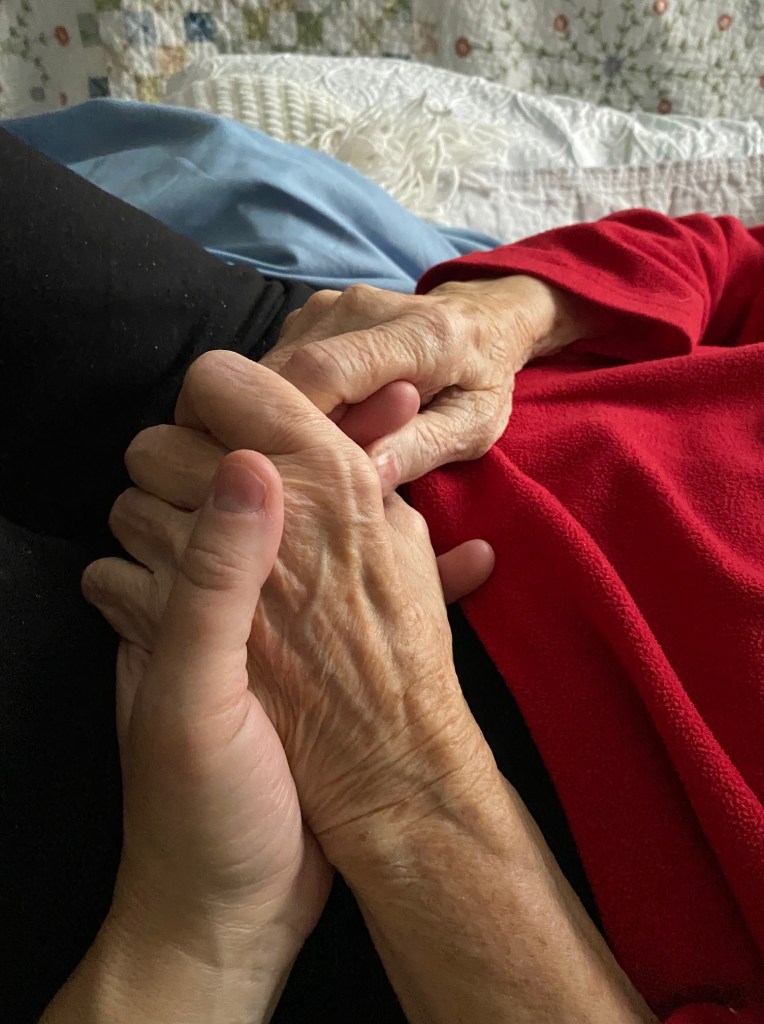
I told myself in those last weeks that I had already lost Mom. She was unconscious, she couldn’t eat, she couldn’t speak, she couldn’t respond. Oh, how wrong I was. The pain of not sitting by her bed, of not holding her hand, of not brushing her hair, is so much more than I anticipated.
It’s been thirteen days since I held her. She was unconscious at the time, breathing what would be her last breaths. And it’s been seventeen days since she held me. Every so often in those last weeks, she would stretch her arms out and attempt to lift herself. Sitting beside her on her hospital bed, I would reach behind her, wrap my arms behind her back, and lift her up. She would pull me in across her chest and hold me, patting my back. I would cry silent tears. Each time, I wondered, was this the last time she would hold me? And then it was.
Maybe I thought that if I didn’t write about it, it wasn’t actually true. That I would be able to drive to East Flat Rock, and she would still be there.
She isn’t.
The funeral home is asking for her obituary. Words fail me. How to sum up a person’s life in mere words? How to capture love in characters and punctuation?
Shortly after her passing, I left Asheville. There were too many memories, too raw. Am I running to? Or running from? Possibly both?
Those last days, I sat by her bed. She never woke. I massaged her arms and legs, assisting her failing heart to circulate blood throughout her body. I sang to her. I played her favorite music. I talked to her. I recounted my favorite memories with her. I did not bring up the less favorite memories. What would be the point? I told her how much I loved her. I told her how much everyone loved her. I thanked her for the gifts she had given me. I prayed. I cursed.
This was not how it was supposed to be. When Mom was diagnosed with Alzheimer’s, Dad took care of her in their home. I moved back east to support Dad. In my head, the plan was that Mom would pass, and Dad and I would be buddies. Dad then contracted a rare blood cancer, and died months later. Dad was my person. We got each other. We supported each other. We celebrated each other. On his deathbed, Dad asked me to take care of Mom. I was angry. That wasn’t what was supposed to happen. Dad had showed he loved me; Mom had not. I couldn’t refuse Dad anything. Ever. I said of course I’d take care of Mom.
And I did. I moved her to Asheville. I bought a home for the two of us. When she needed more care, I found a facility that could provide that.
And I came to love her in a way I never had. I have to believe Dad knew what he was asking, and he knew the gift he was giving. By the time Mom passed, I adored her. I adored how she loved on everyone. I adored how she called everyone honey, sweetie. I adored how she smiled, up until she couldn’t. I adored how she wasn’t jaded, and was open to everything.
And now she’s not. Not in this world. Perhaps in the future I will be able to feel her love from beyond. But right now it’s simply a void. A painful, hollow, seemingly never-ending void.
I’ve stayed with Mom round the clock since Monday. A lot of that time has been spent watching her sleep, holding her hand, stroking her hair, or snuggling up to her in the twin hospital bed. Ashley was here for a few days and we sat on either side of her, each holding a hand. For the past 53 hours, she hasn’t awoken. She doesn’t respond to touch. Her limbs are weak and her breathing labored. I play soft music, I sing quietly, I tell her we love her (naming everyone in our family), I tell her it’s okay to let go, I tell her I’m leaving for a bit (and go into the hallway in case she wants to pass alone), I sit silently and watch her breathe, I tell her that Dad’s waiting for her, and I tell her we’ll be just fine.
We’ll eventually be just fine.
I wonder, does she hear these words? Does she sense we’re with her? Is she already in another dimension? Is she in pain? Is she scared? More than anything, I hope she’s at peace.
Mom has become more and more agitated over the past few days. The meds they have for her – morphine, lorazepam, haloperidal – don’t seem to help settle her anymore. Beginning around 5:30 am when the quetiapine that she takes to help with sleep wears off, she attempts to climb out of her hospital bed, not realizing that her brain’s signals don’t quite make it to her legs anymore, and she will simply crumble if she tries to stand. She scoots closer and closer to the edge, til I wake up and see what she’s trying to do. I bounce over, lift her legs, and swivel her hips back onto the bed, then crawl in beside her. I snuggle up and pin her legs in mine, keeping them from drifting towards the edge of the bed. Temporarily. Eventually she wriggles free. She’s determined to be upright, so I roll the geri chair over to her bedside. I help her sit on the edge of the bed, legs swinging off the side. I explain what I’m about to do. “Give me a big hug, Mama. I’m going to lift you up, then we’ll sit in the chair, okay?” I lift her up and she groans. I sit her in the chair and place blankets over her legs before gently reclining her. We roll into the living room and sit in the rays of sun coming through the window. Within a few minutes, her legs are slowly moving to the side of the footrest. She wants up. I gently center her legs on the footrest. She grabs at the air, her arthritic fingers tapping. “Come in!” She yells. “Who’s here, Mama?” She stares at me blankly then closes her eyes again, more in her world than in mine. This cycle goes on, over and over. She becomes more and more agitated each time I move her feet back to the center of the footrest.
She suddenly bolts upright, opens her eyes, and yells, “ICE CREAM!” I can’t stifle the laugh that is rising, and am grateful for the momentary diversion. “Would you like some ice cream, Mama?” She has already leaned back in the chair and closed her eyes. “Mm hm…” she mumbles. I bring her an ice cream sandwich, feeding it to her minuscule bite by bite, thankful she is at peace, at least for a bit.
I arrived. She was snoring, which meant she was still alive. The staff told me she ate a few bites of breakfast then was so tired they put her back to bed.
So I’m sitting at her bedside, waiting for each breath in, and experiencing relief with each snore out, and crying.
I’m holding so many opposing thoughts at once. I want her to be at peace. I want more time with her. I don’t want her to be in pain. I wonder if the meds are hastening her death. I miss my team at work. This is the most valuable way I can spend my time.
I wonder what’s going through her mind. Does she realize she’s preparing for death? Does time have any relevance? Can she differentiate between all the women holding her and whispering they love her? Does she know she’s loved?
When I entered Mom’s room on New Year’s Day, she was still in bed asleep, though it was almost noon. I could tell by how she was curled up in the fetal position and the grimace on her face that she was in pain. The staff mentioned that she had been in pain all night, in and out of sleep, and had fallen when she tried to get out of bed that morning. I bent over her and kissed her forehead and she groaned. I stroked her hair and she wailed. Anywhere I touched her she cried out in pain. I asked the staff to please administer the morphine dose that was to be used as needed. It didn’t seem to help, Mom continued to cry as I held her. I cried as well, quietly at first, and then not so quietly. She looked down at my head on her chest and clearly said, “What is wrong with you?” The iciness of the words let me know that part of her was still in there; she had used that phrase often as I was growing up, particularly when she wasn’t happy with my actions. Those were the only words she said clearly that day.
A hospital bed was wheeled into her room later that day (she had been sleeping in her own bed up to that point). We transferred her to the hospital bed and I sat beside her and continued to hold her hand, telling her it would be okay.
Since New Year’s Day, she’s stopped eating food, seemingly forgetting how to chew, and not interested in purees. She can’t seem to work out how to use a straw, and simply curls her mouth around it. I give her liquids with a syringe or with a sippy cup (often spilling the juice down her gown or shirt and apologizing profusely while dabbing at the errant drops). She lays in bed staring with glassy eyes at something I can’t see. Occasionally she’ll try to talk, but the words come out as garbled sounds, as though her mouth is full of pebbles.
Today we transferred her to a wheelchair. I asked her if she’d like to go for a ride and she nodded and mumbled, “Oh, yes.” I wheeled her chair up and down the hallway; the same hallway we had shuffled down just last week. She yawned and I asked if she was tired, and she stared at me then after a long pause in which I started to think she hadn’t heard me, said, “Yes.” We transferred her back to her bed, and immediately heard her snores. I sat beside her, holding her hand as she slept. At one point her eyes flew open, and she yelled, “Jerry!” I told her Dad was with her, and silently asked Dad to help her with this transition, so that she’s not in pain. And also said a moment of thanks that I still have these moments with her. Even though we’re not speaking, this time is so precious. I hold her hand, whisper all the things I’ve told her before, and all that I haven’t, and am grateful for one more day together.
Mom stared at me quizzically when I entered her room. I said (loudly, because she won’t wear her hearing aids), “Hey Mom, it’s Lori, your daughter,” and went in for a hug. She trembled then melted into my hug. She mumbled, took my hand, and in her socked feet, started shuffling towards the living room. We got to the love seat, and I helped her turn around and lower herself onto the cushions. I sat beside her and she snuggled closer. I put one arm around her, and held her hands with my other hand. She dropped her head onto my shoulder and promptly fell asleep. We stayed that way for an hour until her beau shuffled up and said, “Hey! What ‘cha doing?” Mom drowsily opened her eyes and patted my leg, her cue for “Let’s go.”
I helped her stand and we shuffled through the two hallways. She shuffled back to the love seat and stood there. I asked her if she’d like to rest, and she nodded. I positioned her in front of the love seat, then gently sat her down. I put my arms around her to hug her, and she again put her head on my shoulder and fell asleep. A bit later, the hospice social worker arrived for her check in. In a whisper, I asked her to pull up a chair. Mom stirred and I stroked her hair. As the social worker and I talked in hushed voices, I wondered if Mom really was asleep, or if she was pretend sleeping like I used to do as a child, eavesdropping on the adult conversations.
After the hospice worker left, Mom awoke and pulled my hand. “C’mon.” I helped her up and we did a lap through the facility hallways then ended back on the love seat for the third nap of the afternoon. There are days, like today, when a simple walk tires her out and most of our time together is spent napping. I don’t mind these days. I focus on how her skin feels, what her hair smells like, the rhythm of her breathing. I want to sear it into my brain so that I’ll never forget. I know I will forget.
Upon the third waking, Mom rubbed her eyes, looked at me, startled and afraid, and said, “Who are you?!?!” I hugged her tight, kissed the top of her head, and told her I loved her. I’m the person who loves her.
After our standard greeting of a long hug and me saying, “I love you,” and Mom parroting my words (which happens often now), Mom leads me to the somewhat dingy brown love seat in the common area. I really try not to be a germaphobe, and it takes so, so much effort, especially on upholstered furniture, where residents may have had accidents. “It’s okay,” I remind myself. “There are more important things. Being here with Mom is what is important. Everything can be washed.”
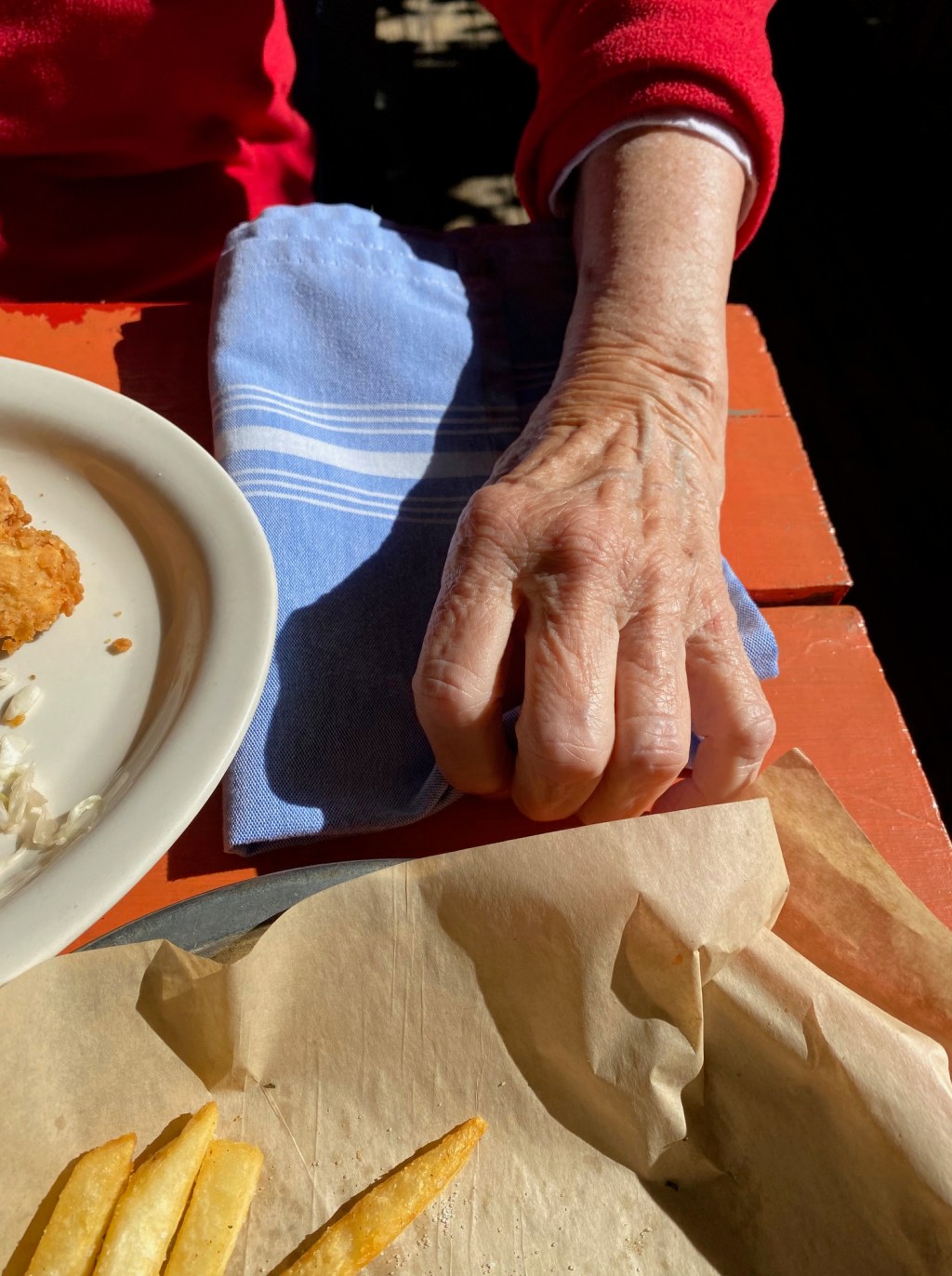
I sit down, and help her into her spot beside me. She snuggles close and lays her head on my shoulder. I put one arm behind her and pull her close. With my other hand, I stroke her bare arm, shocked she isn’t in layers of clothes, as she always complains she is cold. Her skin has always been so soft. It’s becoming thinner and thinner, and age spots are becoming more prominent. The age spots have a different texture, almost sand papery. My fingers catch on them a little as I rub my hand over them. This fascinates me.
Mom mumbles as she lays on my shoulder. Every so often I hear what might be a word and I repeat it. Mom agrees and keeps on. It’s a cold, gray day outside. This feels right, to be inside, on a love seat, snuggled close together.
Her beau, shuffling through the room, calls me by his daughter’s name, Sherry. At first, I don’t respond, and he keeps yelling til I say, “Hi there, whatcha need?” He wants to know what we’re doing, sitting there, hugging each other. I tell him we’re just talking. He thinks for a moment, then satisfied, he saunters away.
Another resident leans over a table in the corner. Perhaps he worked in the government. Perhaps he was a spy. Perhaps he has other voices in his head. Perhaps all of that. He runs his fingers over the grain of the table and says that it’s important that we keep watch. We can’t let them in. He asks if we’re being careful. I assure him we are.
I attempt to take a selfie of me and Mom every time we’re together. Lately, though, when Mom sees the phone, she thinks I’m trying to show her something, and she reaches to pull the phone closer so that she can see. I have a lot of pictures similar to this on my camera roll.
Bathroom
Mom tells me she needs to go to the bathroom. We walk the twenty steps to her room and I help her into the bathroom and slide the bathroom door closed. She positions the trash can behind her as though she’s going to sit on it. “Hey Momma, let’s go this way,” and I guide her gently towards the toilet. “Oh, yes.” She stands there, in front of the toilet. I ask her if she needs to use the bathroom and she says yes. I help her pull down her corduroy pants, and start to pull down the adult diapers that she now wears. She smacks my hands and says, “No!” I step back and ask her if she needs to use the bathroom, and she says yes as she pulls up her corduroy pants. She gets the elastic waistband of her pants situated just so, then tells me she’s done. Sometimes yes means yes, and sometimes yes means no. There isn’t rhyme or reason to when the meaning is true, and when it’s the opposite.
Nap
Mom lets out a large yawn. “Are you tired?” She nods and we walk to her bed. I’m wondering if this nod means yes, or if this nod means no. “Would you like to lay down?” “Yes,” she says as she tries to pry off her tennis shoes, unsuccessfully. As she sits on the bed, I kneel down to untie her double knotted shoelaces. She crosses one leg over the other and kicks me in the head. “Sorry!” I laugh and continue to take off her shoes. When I stand up, she hugs me tightly around my waist, and says, “Sorry. Sorry. Sorry.” “Hey, Momma. It’s okay. It’s okay.” She leans backwards and skooches further onto the bed. She turns to one side and curls up. Okay. So yes meant yes this time. I crawl onto the bed behind her and put my arm over her. She holds onto it tightly with both hands. Pretty soon I can hear her breath, in a steady rhythm, in and out. In and… Oh goodness. Has she stopped breathing? And out… I continue to listen to her breathing, and then hear her snore. She shifts a bit and I realize it is my snore, not hers. I change my breathing so as not to disturb her.
Dinner
I sit next to her at the table, in yet another upholstered chair, overlooking the stains and refusing to think about what they might be. The angel on staff places a plate in front of Mom. Cream of broccoli soup in a small bowl, and a meat and cheese sandwich, cut into triangles (the proper way to cut a sandwich), not rectangles. Mom picks up the bowl of soup, and attempts to pour it onto her plate. I gently tip her hand back so that the soup won’t spill, and guide her to set the bowl on the table. I ask Mom if she’d like some soup. She nods, so I bring a spoonful to her lips, prepared for her to swat it away. She opens her mouth and eats it, and seems to like it. I continue feeding her spoonful by spoonful until she notices the sandwich. I pick it up and hand it to her, and she gingerly bites one point of the triangle. Then another point. I’m so happy to see her eating. There are so many days when she simply refuses. She eats an entire half of a sandwich. I give her another spoonful of soup. Once the chunks of broccoli are gone, she has no interest in the soup. She picks up the other half of the sandwich and I’m astonished. This is the most I’ve seen her eat in a month. She finishes the second half of the sandwich. I hug her and kiss her forehead. She is handed a fudge cookie, wrapped in plastic, for dessert. She can’t quite figure out how to pull back the plastic, so I pull it back halfway, so that her fingers won’t get sticky. After she eats the unwrapped half of the cookie, she puts the plastic wrapped portion in her mouth and sucks. I pull back a little more plastic so she can access the cookie. She uses her fingers to push the cookie into her mouth. She hates having sticky fingers, a trait she has passed on to me. As I watch, she dips her fingers into her cup of chocolate Ensure, then rubs her hands together as though she’s washing her hands. This makes her hands stickier, and she is growing agitated. I help her out of her chair and lead her to her bathroom, where we wash both of our hands under warm water, using an ample amount of soap.
Bedtime
I help Mom into a nightgown and long underwear. We take off her shoes (again). She lays down on her side, facing me. She pats the bed, so I sit in the curve of her body. She wraps her arms around my waist. I stroke her long, silky, gray hair. Her eyes grow heavier and heavier. Each time I stop stroking her hair, her eyes strain to flutter open. So I continue, alternating with stroking the place where her eyebrows once were, remembering all the times I begged her to “play with my hair.” I love the feeling of someone running their hands through my hair, of brushing it, of braiding or twisting it. So many times she told me no, that she didn’t have time, or she was too busy. I love that I can give her this gift of comfort.
I walked into Mom’s room as she held a wicker basket to her lips and tipped it backwards. “Hey, Momma. Are you thirsty?” She nodded and continued to tilt her head further backwards. I gently took the basket from her hands and gave her a glass of water. She sipped it, and sipped it, and sipped it, emptying the glass in a few swigs.
We walked to the car, and I helped her get in the passenger’s seat, then buckled her seat belt. As I settled into the driver’s seat, I noticed she was gnawing on the seat belt. “Are you hungry?” “No,” she said as she continued to chomp on the tough webbing.
At our favorite restaurant, Mom pushed her food around her plate with her fingers. Utensils prove to be too challenging these days. I tore part of a chicken tender into a bite size piece and fed it to her. She chewed methodically, staring into space. “Momma, want a French fry?” I asked as I held one out to her. She took the long skinny potato, inserted it into her mouth, and began the motions of brushing her teeth. After a few seconds, she switched to the other side of her mouth, then laid the soggy French fry on her plate.
At the park, we sat on a bench, listening to bird songs and watching clouds drift by. She leaned over and picked at my sneaker. “What ‘cha need, Momma?” Wordlessly, she picked up my heel, put it in her lap, and cradled it like a baby. She rocked it gently back and forth, looking at it tenderly. I felt a cramp sneaking into my hip, so I turned slightly so that she could continue rocking, and I would (hopefully) still be able to walk when she was finished.
What is she seeing with her now glassy hazel eyes that used to be the color of black coffee? What is she dreaming of as she rocks my foot? Does the wicker basket quench her thirst? Is it the motion of drinking that satisfies her? Or is it the actual liquid in her throat? I hold her tight and kiss the top of her head, wishing I could understand her thoughts.
I sensed I was walking into a not-great situation. One of the newer employees was standing over Mom, who was sitting in a chair, her back to me. The employee was staring Mom down and wagging her finger at her. “Heyyyyyy,” I said tentatively as I walked up behind Mom. She turned around and stared at me with a look I recognized from childhood. She was furious and steely eyed.
I bent down to Mom’s level and hugged her. “Hey Momma. I love you.” The employee said, “Miss Sybil, why don’t you tell your daughter what you’ve done this morning?” I looked up at the employee questionably. “Um… I don’t think that’s going to happen. You know she has Alzheimer’s, right?” After no response from either, I said to the employee, “Why don’t you tell me what happened?”
She went on about how Mom had wandered into another resident’s room, and spilled some pineapple juice. And Mom had walked in on another resident using the bathroom (to be fair, he keeps his bathroom door open at all times…). And Mom had poured the coffee out of the carafe in the kitchen. And she had thrown away the remote controls, and now they would have to buy new ones. The whole time I hugged Mom tightly, and covered her ears. I didn’t want her to her the condemnation in the woman’s voice. When she finished, I simply looked at her and said, “You do realize that Mom isn’t doing any of this intentionally. She’s preparing to die.” The employee told me she knew all about death, that she cared for her mother for seven years. At home. I didn’t need to tell her anything. My steely-eyed gaze matched Mom’s. The employee said she was going to fix lunch, and would Mom like something to eat? “No.” She’d be happy to fix me a plate as well. “No.” She left to go into the kitchen, but before leaving, said, “This is the calmest that Miss Sybil’s been all day.” I wanted to scream and say, “It’s because I’m not yelling at her!” Instead, I stared at her silently and pulled a chair up beside Mom.
I continued to hug her and rock her. She cried on my shoulder, and mumbled, occasional words rising. “Kill,” “hurt,” “Jerry.” I was listening with my heart, not my ears. “Dad’s right here, Mom. He’s okay. No one’s going to hurt him. Are you ready to see him?” She continued to cry against my shoulder, and I found myself crying as well. Crying because this is such a cruel disease. Crying because I would remember this, and grateful that Mom wouldn’t. Crying because, well, that’s all that I could do.



 LoriLoo