I walked into Mom’s room as she held a wicker basket to her lips and tipped it backwards. “Hey, Momma. Are you thirsty?” She nodded and continued to tilt her head further backwards. I gently took the basket from her hands and gave her a glass of water. She sipped it, and sipped it, and sipped it, emptying the glass in a few swigs.
We walked to the car, and I helped her get in the passenger’s seat, then buckled her seat belt. As I settled into the driver’s seat, I noticed she was gnawing on the seat belt. “Are you hungry?” “No,” she said as she continued to chomp on the tough webbing.
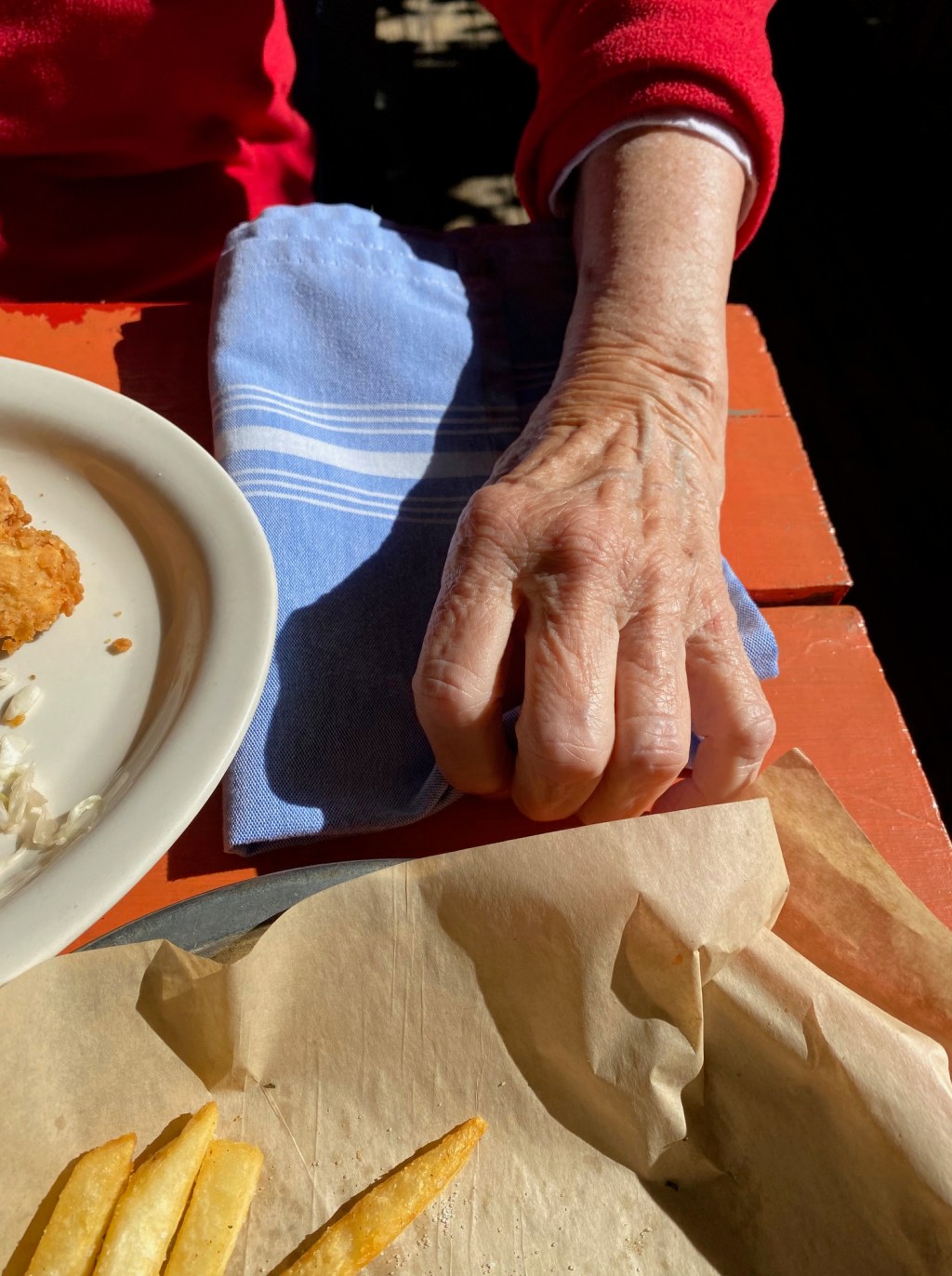
At our favorite restaurant, Mom pushed her food around her plate with her fingers. Utensils prove to be too challenging these days. I tore part of a chicken tender into a bite size piece and fed it to her. She chewed methodically, staring into space. “Momma, want a French fry?” I asked as I held one out to her. She took the long skinny potato, inserted it into her mouth, and began the motions of brushing her teeth. After a few seconds, she switched to the other side of her mouth, then laid the soggy French fry on her plate.
At the park, we sat on a bench, listening to bird songs and watching clouds drift by. She leaned over and picked at my sneaker. “What ‘cha need, Momma?” Wordlessly, she picked up my heel, put it in her lap, and cradled it like a baby. She rocked it gently back and forth, looking at it tenderly. I felt a cramp sneaking into my hip, so I turned slightly so that she could continue rocking, and I would (hopefully) still be able to walk when she was finished.
What is she seeing with her now glassy hazel eyes that used to be the color of black coffee? What is she dreaming of as she rocks my foot? Does the wicker basket quench her thirst? Is it the motion of drinking that satisfies her? Or is it the actual liquid in her throat? I hold her tight and kiss the top of her head, wishing I could understand her thoughts.
 LoriLoo